People arrive early to meeting rooms because nobody else is making the room ready. In most workplaces room readiness is not an assigned outcome of meeting management, so people produce it privately: someone gets there ten minutes early, wakes the screen, moves a chair and checks whether the coffee arrived. That habit is not diligence. It is a workaround for a promise the calendar made and nothing in the building was asked to keep, and it fails most visibly at the one moment you would never choose: in front of the client.
08:57. External meeting at nine. The client is already seated, because reception showed them straight through. The host is at the panel trying to get the screen to pick up their laptop. The coffee that was ordered has not arrived, and nobody in the room can tell whether it is late or whether it stayed behind in the room this meeting was moved out of yesterday. Three minutes to go, and everyone in the room can see all of it.
Nothing in that scene is a technology failure in the way most workplace teams log it. There is no ticket. Nobody will report it. By 09:10 the meeting is running and the moment is gone, and the only lasting record is in the mind of the guest, who now knows something about how this organization runs.
The Cost Lands Where Nobody Measures It
Inside the building, a meeting that starts seven minutes late reads as a small annoyance. That framing is what keeps the problem unfunded. For an organization whose meetings are mostly internal, seven minutes is time. For a law firm, a bank, an advisory practice or a public authority hosting a supplier negotiation, those seven minutes are credibility, spent in front of the counterparty, in a room your organization chose, prepared and paid for.
That is the reframe worth carrying upstairs. The workplace team experiences a readiness failure as friction. The client experiences it as evidence.
Why Do Meetings Start Late When Nothing Is Broken?
Ask why a meeting did not start on time and the answer nearly always arrives as a technology story, because the screen is the part of the failure everyone in the room is looking at. Separate out what actually goes wrong and a room fails to be ready in four ways:
- The kit does not work. The screen will not pick up the laptop, the audio drops, the room joins the call twice.
- The room is not set up for this meeting. Wrong layout, chairs stacked from yesterday, the previous meeting’s cups on the table.
- A service attached to the meeting has not landed. Catering, equipment, a reset somebody was supposed to be told about.
- The guest is still downstairs. They are at reception, waiting for a host who assumes they have been let in.
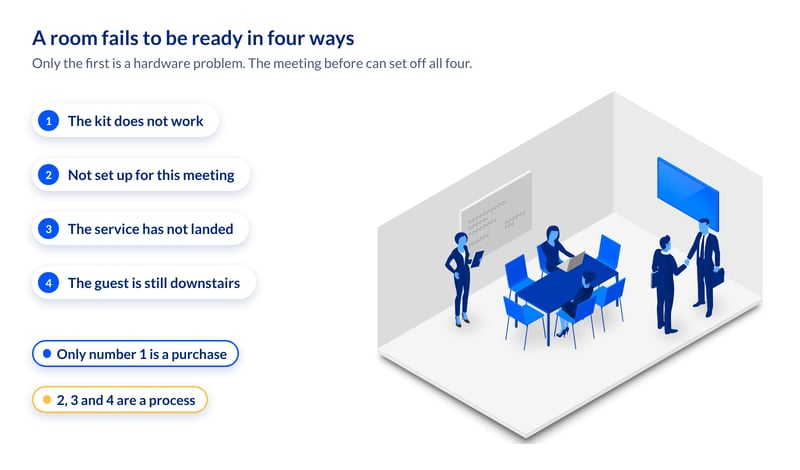
Underneath all four sits the meeting before. When it overruns, or leaves the room as it found it, every one of the four starts from behind.
Only the first is a hardware problem, and it is the only one you can solve by buying something. That is worth saying plainly, including about ourselves. AskCody does not fix echo, network drop-out or a cable that will not hold a connection. That is somebody else’s craft. What we work on is why the other three keep happening in organizations that already bought good software: the booking records what was intended, and nothing is accountable for turning that intention into a room.
Why Do People Arrive Early to Meeting Rooms?
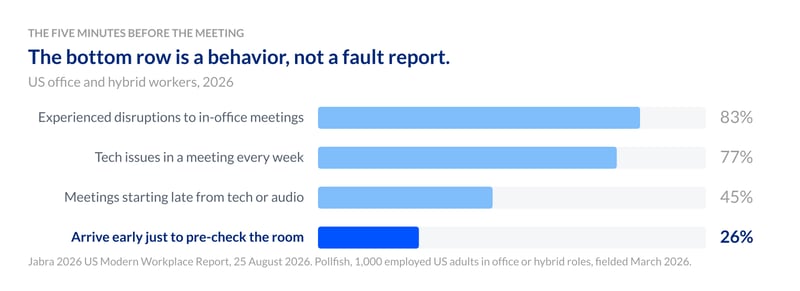
A survey published on 25 August 2026 puts numbers on the scene above. The 2026 US Modern Workplace Report, run through Pollfish among 1,000 employed US adults in office or hybrid roles, found that 83 percent have experienced disruptions to in-office meetings, 77 percent hit tech issues in at least one meeting every week, and 45 percent report meetings starting late because of technology or audio. It is US-scope research from a vendor of audio and video equipment, so read it as directional rather than as a description of your own floor. The operating pattern it describes is not a national one.
Three of those figures are fault reports. They tell you something broke. The fourth is different in kind: 26 percent say they arrive early just to pre-check the room before a meeting.
Nobody schedules that. It appears in no job description, no service catalogue and no operating budget. It is a quarter of the workforce concluding, from experience, that the room cannot be relied on, and rearranging their own morning to compensate. How many people in your building have quietly built those ten minutes into theirs?
Read that way, the number stops being a technology statistic and becomes an organizational one. People do not build private routines around systems they trust.
Reliable Rooms Went From Perk to Condition
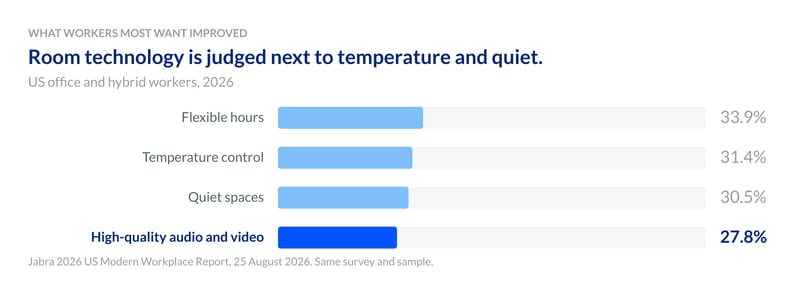
The same survey asked what workers most want improved about the office. High-quality audio and video came fourth, at 27.8 percent, only a few points behind flexible hours, temperature control and quiet spaces. The ranking is the interesting part. Room technology is now judged in the same category as whether the building is too cold and whether there is anywhere quiet to think. It has moved out of the column marked nice to have and into the column marked the place works.
The Gap Between Meetings Is Where the Work Lives
There is a second pressure, and it needs no survey, because it is arithmetic. A room booked nine to ten and ten to eleven has exactly zero minutes in which to be cleared, reset, restocked and re-serviced.
The work does not disappear when the gap does. It is taken from the front of the next meeting, which is precisely where the guest is sitting. What looks like efficiency on a utilization dashboard shows up in the building as a late start. We made the underlying argument when we wrote that booking was never the hard part of a meeting: the visible act is easy, and everything downstream of it is where the difficulty lives.
What Does Room Readiness Look Like in Meeting Management?
If readiness is going to stop being a private habit, it has to become part of meeting management. Four things have to become properties of the booking rather than favors somebody remembers to do:
- Services are attached to the meeting, not to a side conversation. What was ordered, for which room and at what time is visible to the people who deliver it, without a phone call to confirm what the system already knows.
- A change to the meeting changes everything attached to it. When the meeting moves, the catering and the equipment move with it, and the guests receive new arrival details. That is what follow-the-meeting logic is for, and it is the difference between a system of record and a system that holds.
- The gap is protected where the meeting needs preparing. Not a blanket buffer on every room, which nobody would tolerate. Time reserved around the meetings that have something real to prepare, which is how AskCody buffer time works: it switches on only when services are ordered.
- The guest is expected before they arrive. Reception knows who is coming, for which meeting and which host, so the host is not the last to hear that their client is standing downstairs.
An honest boundary belongs here too. A platform can attach readiness to the booking, carry every change to the people who deliver it and show whether it happened. It cannot make a supplier turn up. What it removes is the part that fails most often, which is not effort but transmission: the change nobody heard about, the order that stayed behind in the old room, the guest nobody was told to expect. Last-minute meeting changes are not rare events to design around. They are the normal condition of a meeting operation.
The Question Worth Taking Upstairs
Most workplace teams already know all of this. What they lack is a way to make the cost belong to somebody with a budget. So make it concrete: what does a late start cost when the person watching it is the one paying the invoice, and whose number does that land in?
Answer that in your own organization and readiness stops being a housekeeping matter. It becomes what it has been all along: an operating standard your clients are already grading you against, whether or not anyone inside the building is keeping score.
Key Takeaways
- People arrive early to meeting rooms because readiness is nobody’s job. Where it is not assigned, employees produce it privately and unpaid attention becomes the safety net.
- A room fails to be ready in four ways: the kit, the setup, the service and the guest. Only the kit can be bought away.
- In a client-facing organization a late start is not lost minutes. It is credibility spent in front of the counterparty.
- 26 percent of US office workers arriving early to pre-check the room is a behavioral signal, not a technology one.
- When rooms run back to back, the preparation work does not disappear. It is taken from the start of the next meeting.
- Meeting management makes readiness real by attaching services to the booking, carrying every change, protecting the gap where preparation is needed and expecting the guest before arrival.