Pull the logs on a failed client meeting and every system will testify in its own defense. The room was booked as asked, lunch was delivered as ordered, and reception worked from the list it was sent. The failure lived in the seam between departments: the one part of meeting management with no owner, no queue and no escalation path. In most organizations it has a person instead.
It goes like this. A client meeting is booked for Thursday at ten: lunch for eight, three external guests, the room set for a presentation. On Wednesday afternoon the host moves it to two. One drag in Outlook, four seconds of work.
At ten on Thursday, lunch is wheeled into an empty room. At two, the guests are told at reception that nobody is expecting them yet, and the room is still set for the morning. Nobody did anything wrong. Every system recorded exactly what it was told, and the client saw the one part that failed.
So who was responsible for making that move true everywhere at once?
Nobody Owns The Seam, So A Person Does
Most organizations cannot name a role. They can name a person: a coordinator who checks, an assistant who watches the calendar, a receptionist who keeps a second list because the first one cannot be trusted. Those people are not a process failure. They are the process, and nobody ever told them so.
This is where the usual diagnosis goes wrong. The booking system works. The catering workflow works. The visitor list works. The facilities helpdesk works. Nothing is broken inside any of them. What breaks is the space between them, and that space belongs to nobody: no service owner, no queue, no ticket, no escalation path. We call it the seam, the join where two working systems are supposed to hold and where the load actually lands. It is also why booking was never the hard part of a meeting.
Why Do Meeting Handoffs Break Between Departments?
Because every handoff is a translation. The host holds a calendar entry. Reception holds an arrivals list. The kitchen holds a delivery time. Facilities holds a setup task. When the meeting changes, the change is true in exactly one place, and somebody has to restate it in four other vocabularies before reality catches up. Every restatement is a chance to be wrong, late or skipped.
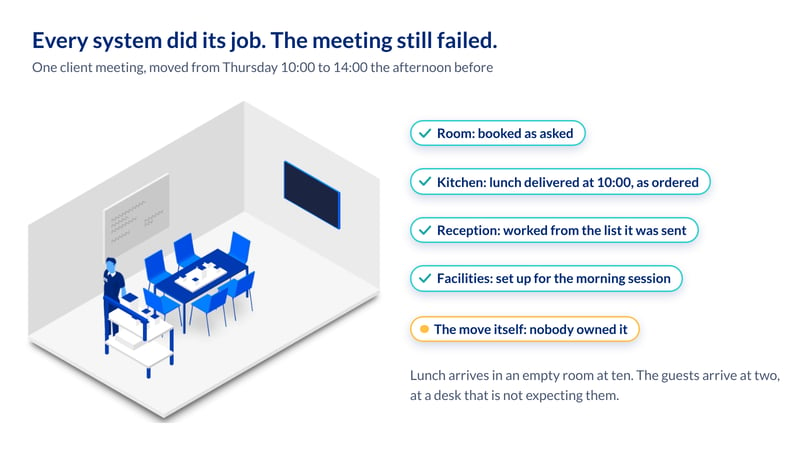
That is why the failure is so consistent. It is almost never the whole meeting collapsing. It is one handoff that did not complete: lunch at the old time, a room set for the previous version, a guest at a desk that is not expecting them. Small, cheap-looking failures that happen to be the only part of the meeting a client sees.
And the number of translations is rising. With 70% of employees now in the office three to five days a week (JLL Global Occupancy Planning Benchmark 2026), more meetings, guests and orders pass through the same seams every day, and they land on the same few people.
The Problem Hides Inside Your Best Person
Notice what organizations do in response. They do not redesign the handoff. They put a human on it. That human gets very good at the job, which makes the problem invisible right up until the week they are on leave, when a load-bearing part of the operation stops and everyone discovers at once that it existed.
If your meeting operation has a single point of failure with a name and a vacation allowance, is that a staffing decision or an architecture decision? The front desk usually feels it first, which is why reception’s view of a workplace is the most accurate one in the building.
A Note For Whoever Owns Microsoft 365
There is an IT reading of this, and it is architectural. The seam exists because there is no single record of the meeting that every role reads from: five teams hold five partial copies, so every change is propagated by hand and reconciled by trust. Another integration between two of those copies adds a sixth thing to keep in sync. The fix is for the meeting to stay in one place, in Exchange and Microsoft 365, with one identity model behind it, and for every role to read its own view of that record. How that works in practice is on our Microsoft 365 integration page.
Who Should Own Meeting Management Across Teams?
Not another department, and not a heroic coordinator. The answer is structural: the meeting itself has to carry the work, and the system has to own what the meeting cannot. In practice that means three things, and none of them is a booking feature.
One record, many views. The meeting is the object. The room, the service order and the guest list ride on it rather than sitting beside it, and reception, the kitchen and facilities each see the version they need from the same source. Nobody retypes anything.
Changes travel with the meeting. When the meeting moves, the order moves with it. When it is canceled, the order is canceled and the kitchen is told then, not at delivery. That is how AskCody Meeting Services handles a catering order.
An honest failure. No system completes every handoff. The kitchen may already have prepared the order; the new room may be one the caterer does not serve. What separates a system that owns the seam from one that merely records it is what happens next: it says so, to the person who can still act, instead of leaving a silent gap for a client to find. Owning the seam is not a promise that nothing fails. It is a promise that nothing fails quietly.
That is the job of a meeting management platform: when the calendar says a meeting will happen, reality should agree, and where it cannot, someone should hear about it before it matters.
Key Takeaways
- Meetings rarely fail inside a department’s system. They fail in the seam between departments, the one part of meeting management with no owner, no queue and no escalation path.
- Every handoff is a translation between teams holding different objects, and each restatement of a change is a fresh chance to be wrong, late or skipped.
- Most organizations staff the seam with one person, which hides the problem until that person is on leave. A single point of failure with a name is an architecture decision, not a staffing one.
- Owning the seam takes one meeting record every role reads from, services that move with the meeting, and an explicit warning when a handoff cannot complete. Nothing fails quietly.