Your meeting rooms can be full all day and still fail the meetings they were built for. In Gensler’s 2026 Global Workplace Survey, 65% of office workers use meeting rooms to work alone, 60% hold meetings at their desks, and 43% have canceled a meeting because no room was free. That is not a shortage. It is a swap, and occupancy data cannot see it. The fix is workplace analytics that measures what each room was booked for, and a building that shows people which rooms are actually free.
The Meeting That Did Not Happen
It is 10:55 on a Tuesday. A client review is due at eleven: four people from the firm and two guests who are already in the lobby. The room that was meant to hold it is taken. Not by a forgotten booking. By a colleague with a laptop and headphones who has been there since nine, because the open floor was too loud to think in.
The host walks the corridor. Room after room: one or two people, laptops open, doors closed. The eleven o’clock moves to Thursday. The guests get an apology. Nothing broke, nobody did anything wrong, and the one thing six people organized their day around did not take place.
It is not a rare morning. 43% of office workers have canceled a meeting outright because a room was not available (Gensler Research Institute, Global Workplace Survey 2026, more than 16,000 office workers in 16 countries; figures as reported by Workplace Design and Facility Executive). Not moved online. Canceled.
The Swap Nobody Approved
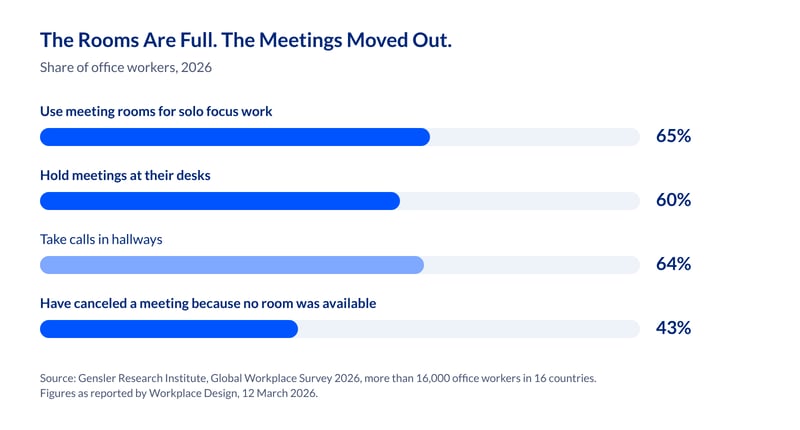
The cause sits in the same survey. 65% use meeting rooms for solo focus work, because there is nowhere quiet to do it. 60% hold meetings at their desks, because the rooms are taken. 64% take calls in hallways. Two-thirds say they regularly work around the shortcomings of their office rather than through it.
Read together, that is not a shortage. It is an inversion. The room built for six holds one person who needed a door. The meeting for six happens at a desk, next to the people who fled into the rooms to escape exactly that noise. Each behavior feeds the other, and the loop closes on the calendar: the next meeting that needs a room does not get one.
Nobody is misbehaving. A closed door is the only quiet most floor plans offer, so people take it. A desk is the only place left to meet, so they meet there. The behavior is rational. The building is upside down.
Why Can’t Occupancy Data See It?
Ask most workplace teams how their rooms are doing and they show you occupancy: sensors, badge data, a chart that says the rooms are busy from nine to five. Occupancy tells you somebody was in the room. It does not tell you what the room was used for.
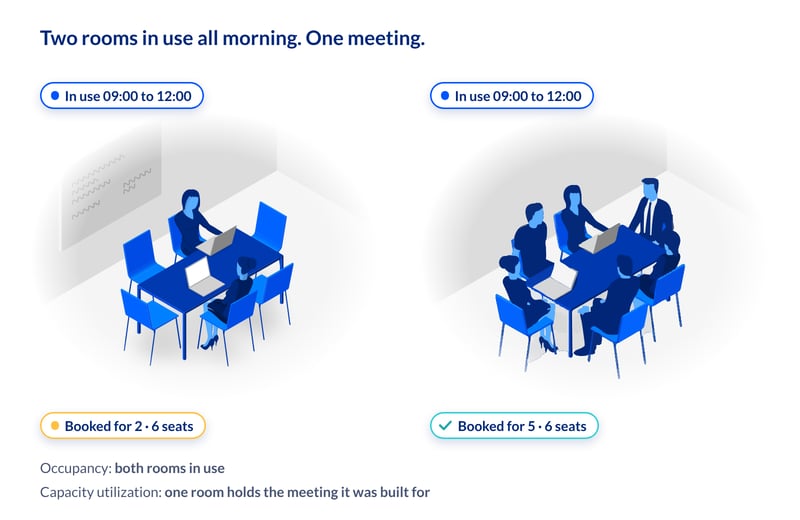
That is the blind spot. A twelve-seat room holding one person on a laptop and the same room holding a client review produce the same green bar. And the meeting that was canceled produces no bar at all, because it never took place. The most expensive outcome a room estate can produce is invisible by construction.
Scheduling data reads the same rooms differently. Capacity utilization compares the number of people each meeting was booked for with the seats in the room, so a room for twelve holding a meeting of two shows up for what it is. Time utilization compares the hours a room is booked with the hours it is open. Together they answer the question occupancy cannot: is this room doing the job it was built for?
How many of last month’s canceled meetings in your building were canceled because the calendar was full, and how many because the rooms were full of the wrong thing?
The Bill Lands On The Meeting
In a law firm, an advisory practice or a corporate headquarters, the meeting is not a supporting activity. It is the product: the client review, the board session, the negotiation with two counterparties in the building. Those are the reasons the office exists, and the reasons people chose to come in on Tuesday rather than work from home.
A canceled focus hour costs an hour. A canceled client meeting costs the hour, the travel of everyone who came in for it, the host’s credibility in front of the people paying the invoice, and a second slot in calendars that were already hard to align. It is the most expensive thing a floor plan can do, and the current arrangement makes it the likely outcome.
It also lands at an awkward moment. November is when next year’s facilities budgets get written, and “we need more meeting rooms” is one of the easiest lines to justify with an occupancy chart. Before that line is approved, it is worth knowing whether the rooms you have are short, or simply invisible and the wrong size for what happens in them.
How Do You Fix A Meeting Room Shortage Without Adding Rooms?
More rooms is the reflex. But if the rooms you have are not being used as meeting rooms, new ones will be used the same way. The other reflex is a rule against working alone in meeting rooms, which punishes the person who was right about the noise and sends them back to a floor that still has nowhere quiet. The practical fix is operational, and it has three parts.
Make availability visible where the decision is made. Much of the swap happens because nobody can see what is free and how big it is. The solo worker takes the first open door. The host cancels because walking the corridor was the only way to look. A live board of every room at the floor entrance and in the lobby, and a display at each door, changes both decisions at the moment they are made. A room nobody booked shows as free, and the host can book it on the spot at the door.
Offer the right size at the point of booking. When the number of attendees comes from the invite, the person booking only sees rooms that fit, each with its capacity. The four-person meeting has a reason to leave the boardroom before anyone needs to police it.
Manage the estate by capacity utilization, not occupancy. The number a Head of Workplace needs is how many people each meeting was booked for against how many seats the room holds, across the estate, by hour. That tells you whether you are short of rooms, short of quiet space, or short of a view of your own building. It is also the honest basis for the next fit-out decision.
Where AskCody Fits
This is the layer the AskCody Platform is built for, inside Microsoft 365 rather than beside it. Meeting Dashboards put live room status on a screen in the lobby or at a floor entrance, read straight from the room calendars, and the room display at each door lets people book a free room on the spot. The Outlook add-in takes the number of attendees from the invite and only offers rooms that fit. And AskCody Insights, AskCody’s workplace analytics, is built on scheduling intent, not occupancy: it shows time and capacity utilization room by room, which is the number that decides whether you need more rooms, more quiet space, or neither.
What AskCody does not do is tell people where to sit. It makes the building visible enough that the swap stops being the rational choice, and it makes the cost of the wrong room visible enough that it stops being free.
The rooms are rarely the problem. The fact that nobody can see them is.
Key Takeaways
- 43% of office workers have canceled a meeting because no room was available (Gensler 2026). It is the costliest outcome a room estate produces, and no occupancy report records it.
- The cause is a swap: 65% use meeting rooms to work alone and 60% hold meetings at their desks. The rooms are full of the wrong activity.
- The behavior is rational. A closed door is the only quiet most floor plans offer, so a rule against it fixes nothing.
- Occupancy cannot tell a client review from one person on a laptop. Capacity utilization, booked attendees against seats, can.
- Fix it before you build: live availability where people choose a room, the right size offered at booking, and capacity utilization as the number you manage the estate by.