You have a reliability problem. The evidence is not in a dashboard. It is in the workarounds your best people run every day to keep meetings standing upright: the confirmation call to the kitchen, the spreadsheet behind the reception desk, the assistant who watches a calendar so nothing falls over when a meeting moves. Every workaround is your organization telling you, in its own behavior, that the calendar's promise is broken. Meeting reliability, not meeting efficiency, is the problem worth solving.
It is 8:40 on a Tuesday morning. The operations coordinator is on the phone with the kitchen, confirming an order the system already confirmed. Reception is cross-checking a printed list against a spreadsheet only reception maintains. An executive assistant is watching a 9:00 board meeting inch across the calendar to 9:30, because if she does not tell catering, AV and the front desk herself, nobody will. None of this is in anyone's job description. All of it happens every week. Sound familiar?
The Workarounds Are Not the Problem. They Are the Diagnosis.
Most organizations read these habits as friction to be trained away: people not trusting the tools, teams clinging to old routines. That reading gets it exactly backwards. Your people are not undisciplined. They are compensating, rationally, for a system that records intent but does not enforce it. Read as workplace behavior, the pattern is not resistance to the tools. It is a workforce routing around a gap the tools left open. We made this case in July: booking was never the hard part of a meeting. The calendar is a stack of promises: this room, ready, at this time, with these services, for these guests. What most workplaces lack is not a better way to make those promises. It is any mechanism that keeps them.
The Load Came Back Before the Scaffolding Did
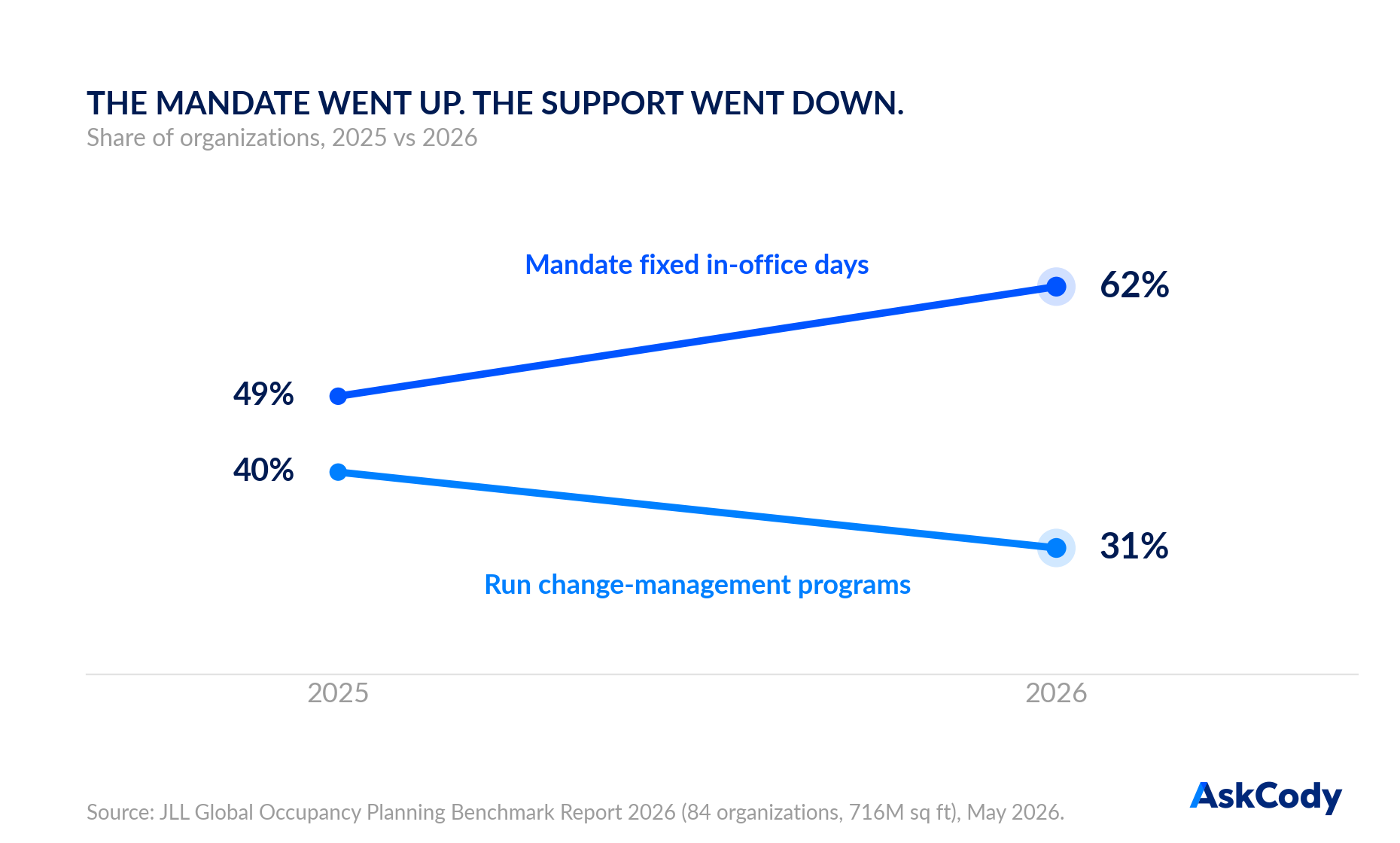
The timing makes this urgent rather than academic. US office visits rose 6% year over year in the first half of 2026, the closest to pre-pandemic levels since 2020 (Placer.ai data reported by Commercial Observer, August 2026). Meanwhile 62% of organizations now mandate fixed in-office days, up from 49% a year ago, while the share running change-management programs to support those mandates fell from 40% to 31% (JLL Global Occupancy Planning Benchmark 2026). And the demand is not spread evenly: utilization peaks midweek at roughly 52% on Tuesdays against 30% on Fridays (XY Sense Workplace Utilization Index, Q1 2026). More people, more meetings, more guests and more catering, concentrated into fewer days, landing on operations teams that did not grow. The workarounds held at 2023 load. They are about to be tested at 2019 load.
The Workaround Audit
Walk the building and count. Each of these exists in most organizations, and each one reveals a specific promise the official system does not keep.
The confirmation call. Someone phones or emails the kitchen, the AV team or facilities "just to be sure" before an important meeting. What it reveals: nobody trusts that a booking triggers execution. The need underneath is certainty, and people are buying it with their own time.
The shadow service system. A catering form, a shared mailbox, an Excel tracker that lives outside the booking flow. What it reveals: after the invite goes out, ownership fragments. A meeting is a cross-functional operation, and in most workplaces it is run as handoffs disguised as a calendar invite.
The human change-propagator. "If you move the meeting, remember to tell catering." An admin who monitors calendars for changes. What it reveals: the system does not heal itself. Every meeting change should cascade automatically to every service attached to it, and where it does not, a person becomes the sync engine.
The space police. Blocked rooms, recurring placeholder bookings, informal rules about who may book what. What it reveals: governance is missing, so fairness is being enforced socially. Policies that do not change outcomes are theater, and people can tell.
The distrusted dashboard. Leaders who ask for utilization data and then decide by anecdote anyway. What it reveals: the record and reality have diverged so often that the record stopped counting as evidence. Data nobody believes is not insight.
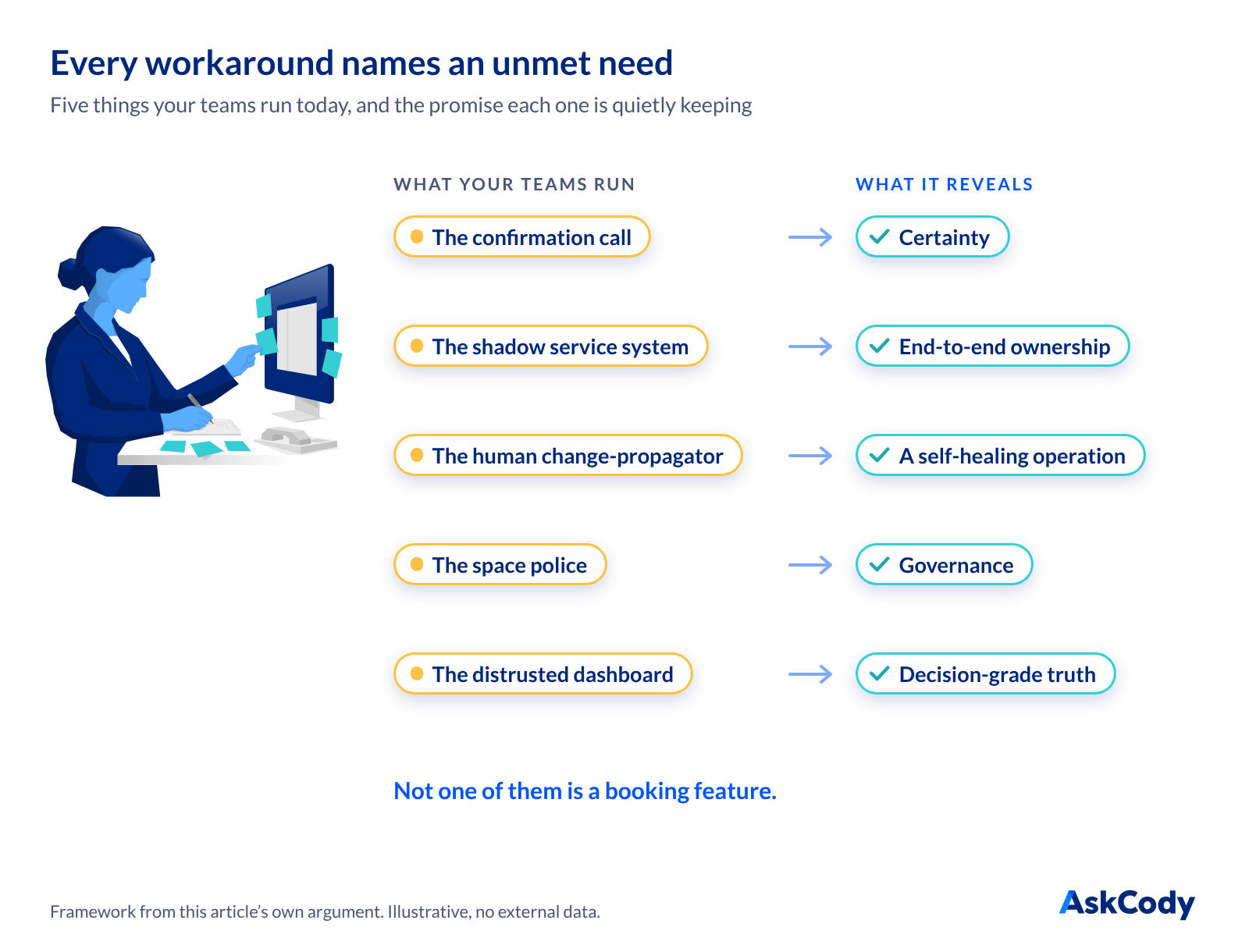
Five workarounds, five unmet needs: certainty, ownership, self-healing, governance, truth. Not one of them is a booking feature.
Where AskCody Enters (Making the Promise Enforceable)
This is the problem AskCody is built for, and it is why we describe the Platform as meeting reliability at scale rather than as a booking tool. The meeting lives in one place, Microsoft Exchange, so there is no second record to drift out of sync. Services are attached to the meeting itself: move it and catering, AV and setup move with it; cancel it and they are released, with the kitchen notified. The guest is part of the same record, so reception knows who is expected and hosts know the moment they arrive. And because the operational chain runs through one workflow, the data it leaves behind is finally worth believing. The workarounds do not need to be banned. They need to become unnecessary.
The Real Cost Was Never the Meeting
A failed meeting is rarely a catastrophe. That is precisely why this problem survives: it fails quietly, one improvised fix at a time, and the cost books itself as busyness rather than breakage. But add it up. The senior people doing confirmation work. The services wasted on changes nobody propagated. The guest who waited in the lobby. The decision made on data nobody trusted. What would your operations team do with the hours the workarounds consume? Organizations do not want more tools. They want a world where coordination is not fragile. The first step is to stop reading the workarounds as habits, and start reading them as findings.
Key Takeaways
- The workarounds your teams run (confirmation calls, shadow spreadsheets, manual change-chasing) are not bad habits. They are evidence of a reliability gap between what the calendar promises and what actually happens.
- Office attendance is at its post-pandemic peak and concentrated on fewer days, while the share of organizations investing in change support has fallen. The load is rising faster than the scaffolding.
- Five workarounds map to five unmet needs: certainty, end-to-end ownership, self-healing operations, governance and decision-grade truth. None of them is solved by booking features.
- AskCody keeps the meeting, its services, its guests and its record in one workflow on Microsoft 365, so the calendar's promise is enforced rather than merely recorded: meeting reliability at scale.