.svg)

Your Meeting Operation Runs on One Person's Memory
It now takes an average of 17 weeks to fill a facility-management vacancy, and nearly four in ten facility managers expect to retire within the decade. The hiring math is not the problem. What those 17 weeks reveal about where your meeting operation has been living all along.
The Morning It Stops Working
Somebody is out. Nothing dramatic: a holiday, a sick day, a new job somewhere else. And by ten in the morning the whole thing is visibly wobbling.
The eleven o'clock in the boardroom has catering ordered, but nobody told the kitchen the meeting moved to the fourth floor. A client is standing at reception and the host is in the other building. The ground-floor room that is always kept free for external visits has a project stand-up in it, because the person who knew it was kept free is the person who is out. Three people who had other jobs today are now solving problems that were not problems yesterday.
Nothing broke. No system went down. The operation simply lost the one thing it was actually running on.
Write Down What Is In That Person's Head
Do it properly, as a list, and it stops looking like a personality and starts looking like infrastructure:
- which of the twelve rooms genuinely seats twelve, and which one only claims to
- which caterer needs 24 hours and which one will still take a call at nine
- that the ground-floor room is held for client visits on Thursdays, by convention, not by rule
- who to call when the AV in the large room does that thing again
- which reception desk covers executive visitors, and which one does not
- that the quarterly finance session always overruns, so nothing goes in after it
None of that is written anywhere. It is not in the booking system, because a booking system holds rooms and times. It is not in a policy document, because none of it was ever a decision. It accreted, quietly, in a person, over years.
So, worth sitting with: how much of your meeting operation could you hand to a competent stranger on Monday, with a document?
Why It Ended Up There
Meeting operations were never designed. They were absorbed.
A room booking tool arrived and solved rooms. Everything downstream of the room, the catering, the setup, the guest at the door, the change of time, the recharge, stayed a human relay. And a human relay is genuinely excellent. It flexes. It improvises. It remembers the exceptions that no rule would have caught. It is also entirely undocumented, and it has exactly one point of failure.
That was a reasonable trade for two decades, because the volume was manageable and the people stayed. Both of those things have now changed, and only one of them changed loudly.
The Volume Went Up. The Team Did Not.
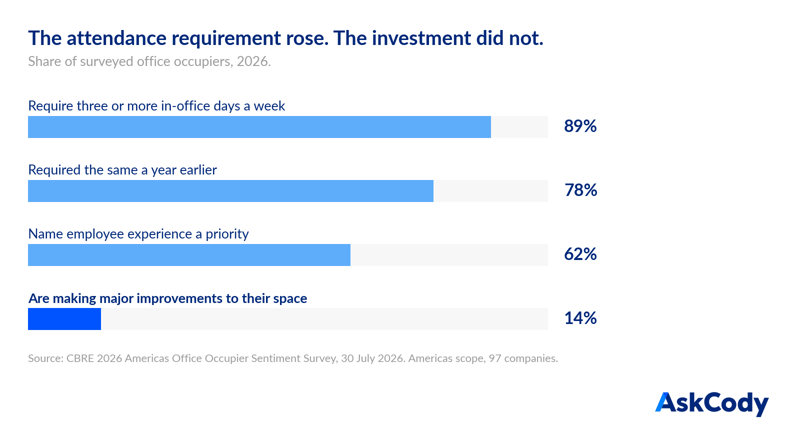
Fourteen percent. Almost nine in ten of these organisations have raised what they require of the office, six in ten say employee experience is a priority, and one in seven is meaningfully investing in the place where that experience happens.
That is the squeeze in a sentence. You are being asked to run a bigger operation with the same relay and a thinner team.
The Profession Can Already See It
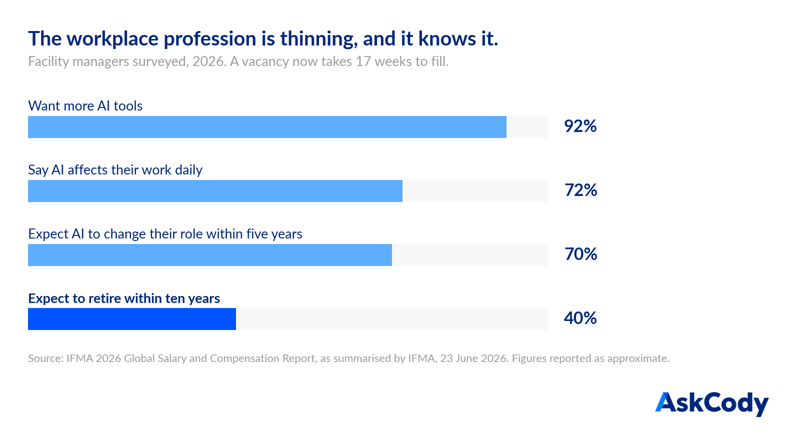
Notice what that chart is not saying. It is not saying facility managers are anxious about automation. Ninety-two percent want more of it. What it shows is a profession that can see the distance between what it is being asked to deliver and how many of them there are to deliver it, and is actively looking for something to close the gap.
Their own leadership agrees, though it said so in different language. Asked what actually improves employee productivity, more than 2,200 C-suite and corporate real estate leaders across 21 countries put advanced technology and AI support at 46% and reliable technology infrastructure at 44%, above adaptable spaces at 31% and wellbeing amenities at 24% (JLL 2026 Future of Work Survey, 14 July 2026). The productivity lever moved off the floor plan and onto the operating layer. Very few organisations have moved with it.
What A Process Has To Hold That A Person Currently Holds
This is where meeting management stops being a category label and becomes a concrete list. To take the relay out of one person's head, something has to hold:
- One booking that carries its own dependencies. Room, services, setup, guest list, all attached to the meeting, so that moving the meeting moves them with it instead of orphaning them.
- one authoritative record of what is booked. Not a copy that has to be reconciled, but the meeting itself, where it already lives, so there is never a question of which system is right.
- Reception seeing what is arriving before it arrives. The guest list is part of the meeting, not a separate email somebody remembered to send.
- services attached to the meeting itself. A service order that reaches the kitchen because it was ordered, not because somebody phoned.
- Conventions turned into data. The room that is "always kept free" either is a rule the system enforces, or it is folklore that dies with the person who held it.
- One place to look afterwards. What did that meeting actually consume, in room time, services and people.
None of that removes the person. It removes the operation's dependence on the person being present. That is the whole difference between a team that is thin and a team that is fragile, and it is a difference you only get to choose in advance.
What 17 Weeks Actually Costs
Seventeen weeks is a third of a year. If the relay lives in someone's head, that is a third of a year in which every exception has to be rediscovered, every convention re-learned, every supplier relationship rebuilt from the invoice up. Then the replacement arrives and spends their first two quarters reconstructing knowledge that was never anybody's fault to lose.
Now run that against nearly four in ten of the profession expecting to retire inside the decade. This is not a hiring problem with a hiring solution. It is a design problem that has been deferred, one competent person at a time, and the deferral is running out.
The people who currently carry this are not the problem. They have been the workaround for a system nobody built, which is exactly why they became the central point of failure. The kindest thing you can do for them, and the most durable thing you can do for the operation, is to stop asking them to be the system.
Key Takeaways
- The fragile part of your meeting operation is rarely the booking system. It is the undocumented relay that sits downstream of the booking, in one or two people's heads.
- It now takes an average of 17 weeks to fill a facility-management vacancy and nearly 40% of facility managers expect to retire within ten years, so the relay's single point of failure is becoming a scheduled event.
- The delivery expectation is rising while investment is not: 89% of surveyed occupiers require at least three in-office days a week, up from 78%, and 14% are making major improvements to their space.
- Leadership already knows where the lever is. More than 2,200 leaders across 21 countries ranked technology and infrastructure above adaptable spaces and amenities as the route to productivity.
- The fix is not more headcount. It is making the meeting carry its own dependencies, so the process holds on the morning somebody is not there.