.svg)

Your Meeting Has A Distribution List. Reception Is Not On It.
When a meeting moves, the organiser spends two seconds on it. One click, update sent, done, and the system did exactly what it was built to do. Twenty minutes later somebody at the front desk is phoning around to find a host, and somebody in the kitchen is wheeling a finished order back down the corridor. Neither of them was told. Not forgotten: never addressed. They were not on the distribution list, because the list contains the people invited to the meeting, not the people who have to do something because of it. No amount of diligence fixes an addressing problem.
It is 9.02. There is a guest at the front desk. The name is not in the system.
The host is not picking up. A colleague nearby thinks the meeting "might have moved". So the receptionist smiles, offers coffee, and starts the routine that every front desk knows and no system has ever recorded: ring round, message a few people, work out who in the building is actually expecting a visitor. Call it the host hunt.
Two floors up, a trolley is going the other way. Lunch for eight, prepared and plated for a meeting that changed rooms an hour ago. Nobody told the kitchen either. The trolley makes the full trip out and the full trip back, untouched. Call that one the return round.
Both of these have names. That is the part worth stopping on. Named things are routine things: you do not develop vocabulary for something that happens twice a year.
Nobody Failed Here
The instinct is to look for the person who dropped it, and there isn't one.
The organiser did the right thing correctly. They opened the invite, changed the room, hit send. The update reached every single person it was addressed to, instantly and reliably. That is not a broken process. That is a process working exactly as designed.
The problem is who the design points at. A calendar invite carries a distribution list, and that list holds the people attending the meeting. It does not hold the receptionist who will meet the guest, the chef who has already started the order, the porter who set the room up, or the AV technician who tested it yesterday. Those people are not attendees. They are dependencies, and the invite has no field for a dependency.
So the change is delivered perfectly to an audience that does not include the people whose work it invalidates. Every downstream failure follows from that one fact, and none of it is anybody's fault.
This Is Not A Meetings Problem. It Is An Addressing Problem.
It generalises well beyond meeting rooms, which is how we know it is structural rather than local.
Atlassian's State of Teams 2025 surveyed 12,000 knowledge workers across six countries, the UK, Germany and France among them, and asked whether their team had an effective process for quickly informing other teams of decisions that affect their work. One in five said yes.

Turn that number over. Four out of five organisations have no reliable way of telling the people downstream of a decision that the decision happened. Not "no tool". No process. The meeting that moved is one instance of a pattern that runs through the whole building.
The same survey shows what people do about it. 56% say the only way to get the information they need is to ask someone or schedule a meeting.
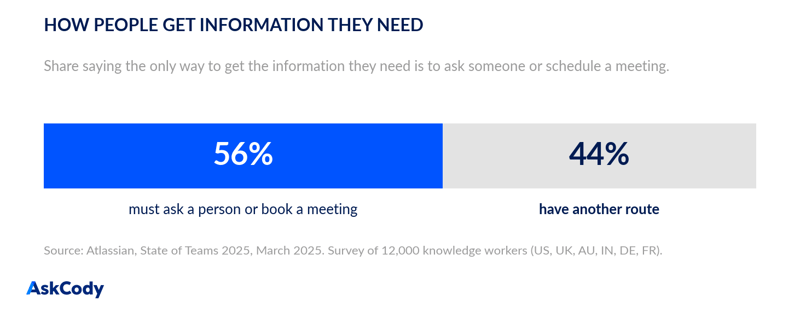
That is the host hunt, arrived at from the other direction. When the system does not carry information to you, the only remaining route is a human. Reception is not improvising because reception is disorganised. Reception is improvising because asking a person is the documented fallback for the entire knowledge economy, and somebody has to go first.
What The Return Round Actually Costs
The kitchen version has a harder edge, because the work is already finished when the news arrives.
A catering order is not a calendar entry. By the time a meeting moves, somebody has read the order, bought against it, prepared it, plated it and staged it. Moving the meeting does not move any of that. It just relocates the room the finished work was heading to.
The scale of what gets thrown away is documented, though not for meeting rooms specifically. WRAP, the UK waste and resources body, reports that almost one fifth of all the food bought by the UK hospitality and food service sector is thrown away, a figure covering the whole sector, restaurants and hotels and contract catering included, not corporate meeting catering on its own. Read it as the order of magnitude the kitchen works inside rather than as a number about your building.
The real cost is not the food anyway. It is that a team produced something correctly, on time, to specification, and it was made worthless by information that existed an hour earlier and never travelled the twenty metres to them. That is a reliability failure, and people feel it as one.
Why Trying Harder Does Not Work
Every organisation reaches for the same two fixes, and both fail for the same reason.
The first is asking people to communicate better. This puts the burden on the organiser, who would have to hold in their head a list of every downstream dependency their meeting has created, including ones created by other people, and remember all of them under time pressure while changing something in two seconds. That is not a discipline anyone sustains. It is not really a discipline at all; it is a memory test with no upside for passing.
The second is adding a notification step. Someone tells reception. Someone emails the kitchen. This works right up until the day it is busy, which is the day it matters, and it is also just the host hunt moved earlier in the process and given to somebody else.
Both fixes accept the premise that the information has to be relayed by a person. That premise is the problem.
Attach The Work To The Meeting, Not Beside It
The alternative is structural and unglamorous: the things a meeting needs stop living on their own lists and start hanging off the meeting itself.
When a catering order is placed against the meeting rather than recorded in a separate system, moving the meeting moves the order, because there is nothing to relay. When a guest is pre-registered as part of the meeting invite, the front desk's overview of who is expected today is reading the meeting, not a list somebody typed up from it. The distribution problem disappears, because nothing is being distributed. There is one record and the dependencies are attached to it.
We have written up the mechanism itself in detail elsewhere, in Follow-the-Meeting Intelligence, and there is no point re-arguing it here. The point of this piece is the diagnosis rather than the fix: if you only take one thing from it, let it be that the guest and the meeting are one record or two, and everything downstream follows from which of those you chose.
For the IT side of the table this is a single-source-of-truth question and nothing more exotic: the calendar already knows the meeting moved, and the only real issue is what else is holding on to that record.
Worth being precise about what this is not. Nothing here is a staff-alerting product with rotas, escalation paths and acknowledgements. Nobody gets paged. The change simply arrives with the work already attached to it, which is a duller and considerably more durable thing than a notification.
Where To Look First
You do not need a project to find out whether this is happening in your building. Ask your front desk how many times last week they had to find a host for a guest who was already standing there, and ask your service team how many prepared orders came back. Neither number is in a system, which is itself the finding. Both people will know it immediately, because it has a name.
The question underneath it is the one worth carrying into your next planning conversation: when something changes in your building, how much of your operation finds out by being told, and how much finds out by walking into it?
Key Takeaways
- The people who absorb a meeting change were never addressed by it. A calendar invite's distribution list holds attendees, not dependencies, so the update reaches everyone it was aimed at and none of the people whose work it invalidates.
- Nobody failed. The organiser did the right thing correctly in two seconds. Treating this as carelessness sends you looking for a culprit who does not exist.
- It is structural, not local. Only one in five knowledge workers say their team can quickly inform other teams of decisions that affect them, and 56% say the only way to get information is to ask a person.
- The return round is finished work made worthless. A catering order is bought, prepared and plated before the news arrives; moving the meeting relocates the room, not the labour.
- Relay is the wrong fix. Better communication is a memory test and a notification step is the host hunt moved earlier. Attaching the order and the guest record to the meeting removes the relay entirely.