.svg)

You Added Rooms. You Didn’t Add Rules.
Half of office occupiers expect to add more flexible, reconfigurable space this year. Almost none of them will write a booking rule to go with it. That gap is not a policy oversight, it is an arithmetic certainty: in most booking stacks, a room with no rule attached is visible to everyone and bookable by anyone. So the room you added to take pressure off the schedule becomes one more way to lose the meeting you could not afford to lose.
The Two-Person Call in the Boardroom
You know the room. It seats fourteen, it has the good camera, it is the room you put the client in. On Tuesday at ten it is holding two people on a video call, because it was free and it was there.
Nobody did anything wrong. The person who booked it opened Outlook, looked at what was available, and picked something available. That is the whole decision. There was no moment in that flow where the system said “this one is for client meetings” and offered them the focus room down the corridor instead.
Then at 10:15 the partner needs somewhere to take an unexpected client conversation, and the good room is gone.
The Mix Changed Faster Than the Rules
This has become more common for a specific and recent reason. The room mix is being rewritten.
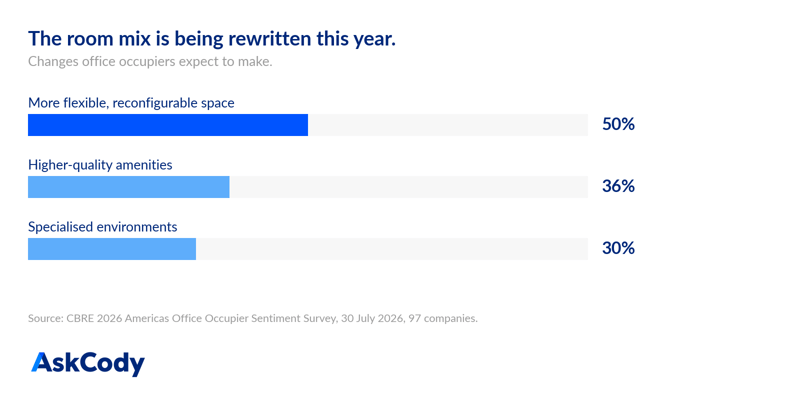
In CBRE’s 2026 Americas Office Occupier Sentiment Survey of 97 companies, published on 30 July 2026, half of occupiers expect to make more use of flexible and reconfigurable space, 36% expect to need higher-quality amenities, and 30% expect demand for specialised environments such as AI labs and innovation spaces. Private offices keep converting into phone booths, focus rooms and small collaboration spaces.
That is a lot of new supply arriving in the estate. Every one of those spaces lands in the booking system as a resource. Almost none of them arrives with an instruction attached.
A Room With No Rule Is Not Neutral
Here is the part that gets missed, and it is the reason this is an operations problem rather than a signage problem.
An ungoverned room does not sit quietly in a corner waiting for the right person to find it. In a standard Microsoft 365 room estate, a resource that has not been scoped is visible to everyone and bookable by anyone. The default is not “no rule”. The default is “no restriction”, which is itself a rule, just not one anybody chose.
So the new focus room is not the problem. The new focus room is fine. The problem is that adding fourteen new bookable resources without scoping any of them increases the number of ways a booker can end up in the wrong space, including the expensive one. You did not just add capacity. You added routes.
And the failure lands where it costs most. Nobody escalates a focus pod. They escalate the boardroom that was gone when the client arrived.
Why It Never Gets Fixed
Not because anybody is careless. Because rewriting a booking policy is a job with no deadline.
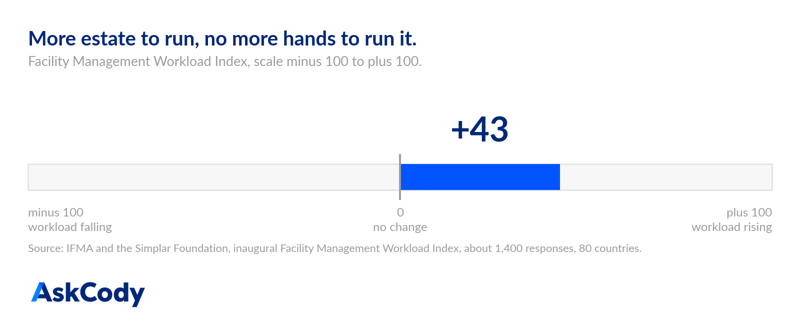
IFMA and the Simplar Foundation put a number on the pressure this year. Their inaugural Facility Management Workload Index reads +43 on a scale running from minus 100 to plus 100, drawn from roughly 1,400 responses across 80 countries, with IFMA describing steady workload growth against modest budgets and constrained staffing. More estate, more change, same team.
Against that, “revisit who is allowed to book the fourth-floor boardroom” never becomes this week’s problem. It becomes the thing that gets handled informally instead: a quiet word, a private list of which rooms are really for what, a manager who has become the human approval layer for a system that was supposed to remove one.
That informal layer works, right up until the person holding it is on holiday.
Governance Is Not a Rulebook for Booths
The instinct when someone says “governance” is to imagine a policy document nobody reads. That is the version that fails.
The version that works is narrower and much less ambitious. It is not about controlling every space. Most rooms should stay open to everyone, and a system that makes people request permission for a huddle room has made things worse.
It is about the small number of rooms where being wrong is expensive: the client-facing rooms, the boardroom, the serviced spaces, the ones with a real setup cost behind them. Scope those, leave the rest open, and the estate absorbs new space without leaking the meetings that matter.
That is the trade. Governance on a handful of rooms buys reliability on the meetings you cannot repeat.
What This Looks Like in Practice
In AskCody, this is Resource Groups: Entra ID security groups are linked to groups of rooms and desks, and people see only the resources they are actually allowed to book when they search in the Bookings add-in inside Outlook. What you see is what you book. The wrong room stops being an option before anyone picks it, rather than being a rejection email that arrives after the invite has gone out.
The important detail is the one in the Help Center, stated plainly: a room that is not placed in a Resource Group stays visible to everyone. The system tells you what its default is. Most estates have simply never been asked the question.
Which rooms in your building would you actually mind losing at ten past ten on a Tuesday? That list is usually short, and it is usually the whole job.
Key Takeaways
- Half of occupiers expect more flexible and reconfigurable space this year (CBRE, July 2026). New room types are arriving faster than booking rules are being written.
- A room with no rule attached is not neutral. In a standard Microsoft 365 estate the default is visible to everyone and bookable by anyone.
- The cost does not land on the new small rooms. It lands on the expensive room that was taken by a two-person call.
- Facility teams are not ignoring this. IFMA’s inaugural Workload Index reads +43, and re-writing a booking policy is a job with no deadline.
- The fix is narrow, not total: scope the handful of rooms where being wrong is expensive, leave everything else open.