.svg)

The Power of Nudging in Creating Better Workplace Experiences
When we talk about workplace technology, it’s easy to get caught up in the race for more. More features. More automation. More dashboards. But at the heart of every successful workplace experience isn’t more... It’s better.
Because ultimately, workplace transformation isn’t just about what technology can do. It’s about how people choose to use it.
At AskCody, we’ve learned that real change happens not when new features are rolled out, but when people’s behaviors evolve. And sometimes, the best way to inspire that change isn’t through another function, rule, or policy. It’s through something far more subtle and powerful: nudging.
What Is Nudging? And Why It Matters
Nudging is a concept from behavioral economics, popularized by Richard Thaler and Cass Sunstein. It’s about designing choices and environments in a way that gently encourages better decisions — without forcing them.
It’s the art of making the desired behavior the easiest, most natural, and most appealing choice.
When you apply nudging and behavioral design in the workplace, you stop fighting human nature and start working with it. You recognize that people don’t always act on policies, rules, or even training — they act based on context, friction, and convenience.
So instead of asking, “What feature can fix this?”, the better question often is:
“How can we design this experience so that the right behavior happens naturally?”
Why Nudging Is Essential When Implementing AskCody (or any Meeting Management Platform)
AskCody is designed to simplify and enhance how people book rooms, manage visitors, and plan meetings. But the true value of AskCody doesn’t come from the software alone — it comes from how people use it.
A smooth rollout and lasting adoption depend on shaping the right habits around meeting behavior, room usage, and planning. That’s where nudging comes in.
When organizations pair AskCody with simple behavioral design principles, they:
-
Increase adoption without heavy-handed enforcement
-
Create better meeting culture and etiquette
-
Reduce frustration and “meeting chaos”
-
Make efficiency feel effortless
10 Simple Nudges That Transform Meeting Booking Behavior and Meeting Scheduling Hygine
Making People More Hygienic About Booking Rooms
1. Put the booking option at the exact moment of need
Instead of telling people to “remember to book a room”, place QR codes, booking displays, dashboards, or a booking shortcut in the tools they already use (Outlook Add-ins) at the moment they are thinking about meeting. When the path to doing the right thing is placed directly in front of them, they follow it without thinking. Visibility itself is a nudge; it reminds and reinforces the habit you want to create. This replaces memory with design, which is far more reliable.
2. Give gentle feedback when behavior slips
If someone repeatedly creates no-show reservations, send a short, friendly message that shows how a released room could help colleagues find space. This taps into social awareness rather than punishment.
People usually want to be considerate. They just need a timely reminder that their behavior matters.
Helping People Actually Show Up
3. Use small reminders at the right time, not many reminders at all times
A single short reminder ten minutes before a meeting, combined with a clear ask such as “Still attending?”, makes attendance intentional rather than accidental.
It transforms showing up from passive habit to conscious decision.
4. Highlight the cost of last-minute cancellations in a simple visual
A weekly internal dashboard that shows how many hours of meeting space were lost to no shows sends a social signal without pointing fingers.
People shift their actions when they see the collective cost of individual habits.
Making Meetings Start and End on Time
5. Shorten default meeting lengths
If the calendar defaults to 25 or 50 minutes, people adjust without complaint. They rarely change defaults.
This single nudge improves punctuality in both directions: it creates natural breathing room between meetings and signals that respecting time is the cultural norm.
And the truth is that most people have back-to-back meetings all day, everyday, but is is impossible to finish a meeting, wrap up, shot down your laptop, take a bio-break, refill your coffee, walk to the other side of the building, perhaps pick up your guests, and be ready for a new meeting in... No time... We need breaks between meetings!
6. Display a countdown timer on room screens
Not a loud alarm, not an intrusive rule, simply a visible clock showing remaining time.
Visibility drives behavior because people pace themselves when they can see time disappearing.
Encouraging People to Book Rooms for the Right Purpose
7. Give rooms names that signal their intended use
A simple but highly effective nudge is to give rooms names that signal their intended use. Instead of generic labels like Room A or Room 3.14, names such as Focus Studio, Decision Lab, Collaboration Hub, or Project Workshop set expectations before anyone even opens the door. The room itself becomes a cue. People instinctively choose a space that matches the nature of their work because the name frames the activity. There is no rule telling them where to go, no policy enforcing correct usage. The environment quietly guides them. This kind of naming uses psychology rather than control, making it more likely that teams end up in rooms that support the purpose of their meeting. It improves outcomes through intention rather than instruction, which is exactly what nudging is about.
People follow the story a space tells.
8. Offer subtle prompts during booking
When someone chooses a large room for a one to one meeting, a gentle message such as “Smaller rooms nearby might be a better fit” makes the better choice feel natural, not corrective.
It shifts selection by making the alternative feel more appropriate.
9. Curate room setups that match the purpose
Another powerful nudge is to guide people toward the right room by asking a simple question at the moment of booking: “What is the purpose of your meeting?” Instead of forcing users to filter by capacity or choose based on whatever room is closest, the system invites them to think about the activity first. Purpose becomes the anchor. A workshop needs space to move. A one to one needs quiet. A decision session needs focus. By prompting people to define the purpose up front, you steer them toward rooms designed for that exact type of work without adding extra rules or configuration. The nudge is subtle, but it shifts mindsets from “Which room is available?” to “Which room supports what we are trying to achieve?” It creates better meetings not through more features, but through a small moment of reflection that improves the match between space and intent.
Encouraging Better Meeting Culture Overall
10. Add small friction to poor habits, not more rules
If people often forget to include agendas, require one tiny field that asks “What outcome should this meeting create?”.
It is not a rule. It is a mental cue. It forces clarity without forcing bureaucracy.
Anti-Tech Decision Boxes for 10-minute Meetings
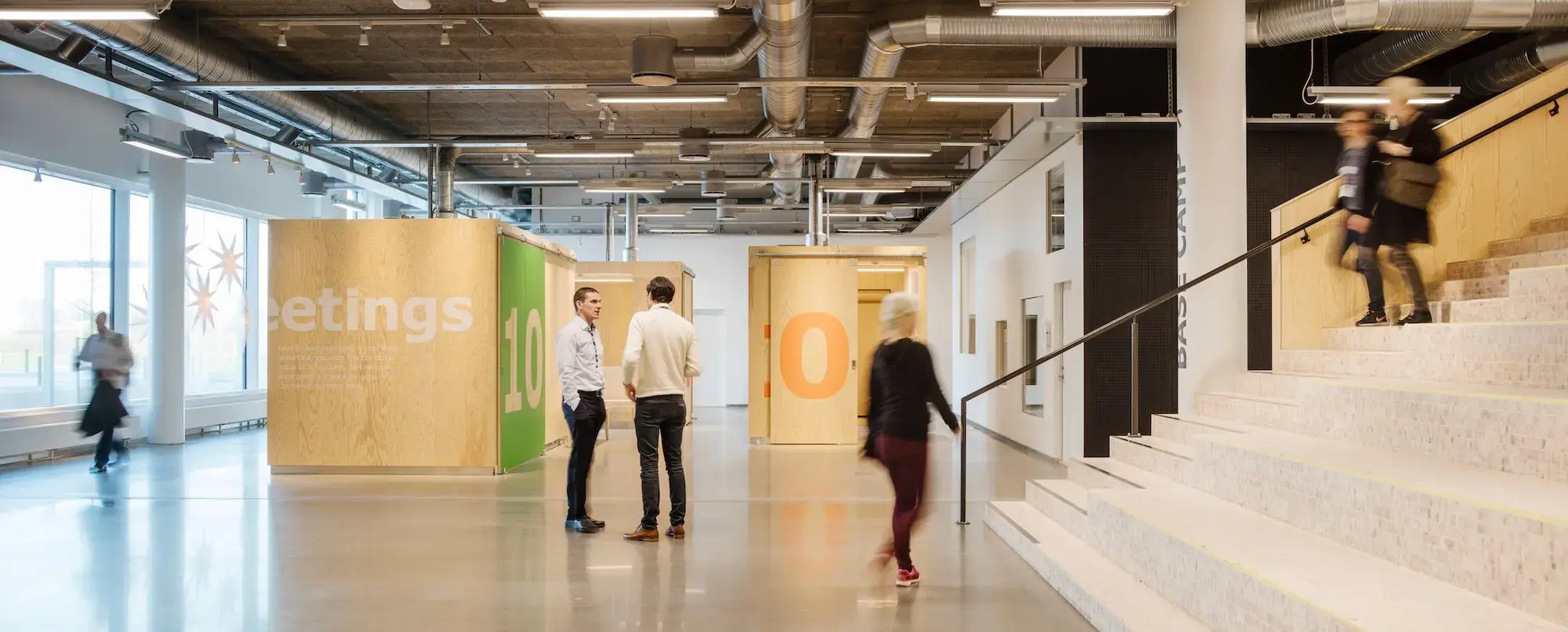
One of the most striking examples of nudging in workplace design comes from a set of meeting rooms that are almost entirely anti tech. This Example comes from IKEA's Meeting Center in Hubhult, Sweden. Each room is a simple wooden box with a single message printed on the wall: “Bear in mind that time is the most important resource you have. You can do so much in 10 minutes. Ten minutes, once gone, are gone for good. You can never get them back.” When the ten minutes have passed, an alarm sounds. Nothing about this space relies on extra features or hardware. Instead, the room reshapes behavior by design. It encourages people to prepare before arriving, because now something is at stake. It pushes conversations toward decisions rather than drifting through fifty minutes of updates. The environment itself becomes a nudge that moves the business forward. It proves that sometimes the strongest catalyst for better meetings is not technology at all, but a thoughtful framework that changes how people use their time.
The example above is powerful precisely because it turns the usual logic upside down. It shows that sometimes the most transformative innovation is not another layer of technology but a shift in how people behave inside a space.
In the photo, you see an open and modern workplace with bright, box shaped rooms marked with large numbers and soft colors. The design is simple, intentional, and stripped of unnecessary complexity. Nothing about this area screams high tech. What it communicates instead is purpose and focus.
Those meeting-boxes become decision rooms by introducing one small but profound nudge. The writing on the wall reframes time as the most precious resource. The ten minute limit imposes a natural constraint. The alarm at the end when the 10 minutes has past, creates closure. None of this relies on software. It relies on human psychology. It encourages preparation because people feel that if they waste those minutes, they lose something meaningful. It encourages clarity because decisions must be made before the bell rings.
The remarkable part is that the environment is doing the teaching. It is shaping expectations and choices without enforcing a rule. This is the essence of nudging. It shows that you can redesign a room without adding anything digital and still change behavior more effectively than any feature update.
The room becomes a framework for better meetings. It signals that decisions matter. It tells people to arrive prepared. It turns the final minutes of a meeting into the most productive ones. And it does this through cues that are physical and symbolic, not technological.
This example is a reminder that workplaces often seek solutions in tools before examining context, habits, or rituals. A space designed with behavioral insight can outperform a space full of devices. A constraint that is thoughtful can unblock more progress than a feature that is clever. Meeting culture is not improved by complexity. It is improved by clarity, intention, and cues that support the behaviors we want to see.
An AskCody favorite: The "Confirm Meeting" function
Ever walked up to a meeting room with a pending meeting about to start? On the screen it says: "Confirm" or "Start Meeting". It's a simple check-in feature, letting you claim the room and confirm, that the meeting is about to start.
The check-in feature is a perfect example of behavioral design in action, and it works precisely because it blends two powerful nudges: a gentle reminder and a meaningful consequence. It does not force people to follow a rule. Instead, it reshapes the moment of choice so that the sensible action becomes the easy one.
Why the Check-In Feature Works as a Nudge
It moves the decision to the moment of truth
People often forget to release rooms simply because the reminder comes too early or too late. By asking for confirmation at the door, the question appears exactly when the person knows whether they will use the space.
Nudges are most effective when they meet people in the moment, not in their inbox.
It makes the right behavior effortless
A single tap on the screen is a low effort action. Releasing a room manually is higher friction.
When the easiest behavior is also the helpful one, adoption grows without training or policing.
It introduces a natural consequence without punishment
If no one checks in, the system assumes the room is not needed and releases it.
This consequence feels logical rather than punitive, which is why people accept it rather than resist it.
It protects the workplace from invisible waste
Unused reservations drain availability and distort capacity planning. Automatic release restores accuracy in a quiet and elegant way.
How to Frame It as a Behavioral Nudge Rather Than a Hard Rule
The power of this feature is not the cancellation itself. The power is the subtle design that encourages people to make a conscious choice, which improves meeting etiquette over time. When framed as a nudge, this feature:
-
Encourages accountability without sounding heavy handed
-
Highlights consideration for colleagues
-
Reinforces a culture where space is shared and respected
-
Reduces the cognitive load on employees
-
Builds new habits through consistent, gentle cues
How It Improves Meeting Hygiene
1. Reduces ghost meetings
Rooms are no longer locked by meetings that no one intends to use.
2. Drives punctuality
People arrive on time because they know a quick confirmation is expected.
3. Improves space utilization
Spaces become available again in minutes, not hours, and someone else can use them.
4. Creates awareness of the cost of no-shows
Without shaming anyone, it makes the invisible impact visible.
5. Changes the cultural expectation
People start to see checking in as part of the meeting ritual, similar to opening the laptop or greeting colleagues.
This is a reminder that thoughtful design can shift behavior far more effectively than adding more configuration options or stricter policies. A small action, placed at the right moment, supported by a meaningful consequence, can reshape meeting culture more reliably than any list of rules.
Behavior by Design
Behavioral design reminds us that change doesn’t have to come from more complexity. It comes from thoughtful simplicity.
Technology like AskCody provides the foundation for smarter meetings, smoother coordination, and better use of space. But it’s nudging, the invisible architecture of choice, that turns those tools into transformation.
If you want to create a workplace experience that truly works for people, start not with features, but with behavior. Because when people want to use the system, you don’t have to make them.