.svg)

Beyond Room Booking: The Data That Makes Your Workplace Run Better
Most organizations have a reasonably good handle on room utilization. They know which conference rooms get booked constantly and which ones gather dust. But ask them how busy their reception is on a Tuesday morning versus a Thursday afternoon, or which catering items get rejected most often, and you'll usually get a shrug.
That's a gap worth closing.
Meetings don't happen in a vacuum. They generate a ripple of activity across your organization, from the moment a visitor checks in at reception to the last item that gets delivered before the session starts. If you're only tracking room usage, you're only seeing part of the picture.
Reception Is a Bottleneck You Probably Haven't Measured
Think about your front desk. During a busy quarter, it can feel like a revolving door. During quieter periods, it's underutilized. The problem is that most organizations don't actually know when those peaks and valleys happen in any consistent, data-driven way.

Staffing decisions end up based on gut feel, or on whoever complained loudest last week. That's not a great foundation for building a smooth visitor experience.
When you can see check-in activity broken down by weekday and time of day, patterns become obvious quickly. Maybe Tuesdays between 8 and 10 are consistently your highest-traffic window. Maybe Friday afternoons are almost empty. With that information, you can actually plan: schedule extra coverage where it matters, reduce it where it doesn't, and stop making visitors wait in a queue because the staffing model was built on assumptions.
This is exactly the kind of visibility that makes the difference between a reception that feels frantic and one that feels effortlessly organized. And it directly shapes how visitors perceive your organization from the moment they walk through the door.
Service Requests Tell a Story Too
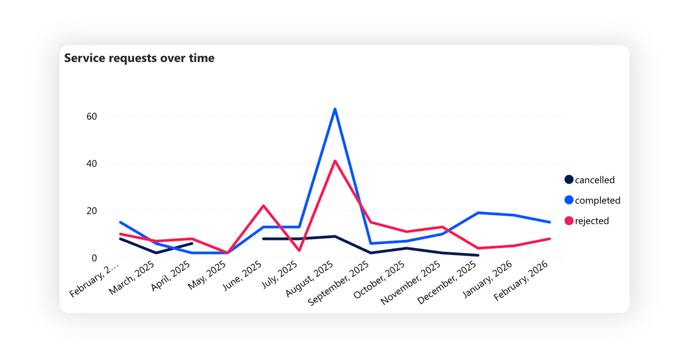 On the services side, there's a similar blind spot. Catering, IT equipment, facility requests -- these get submitted, fulfilled or rejected, and then mostly forgotten. What rarely happens is looking at all of it together to understand what's actually driving demand.
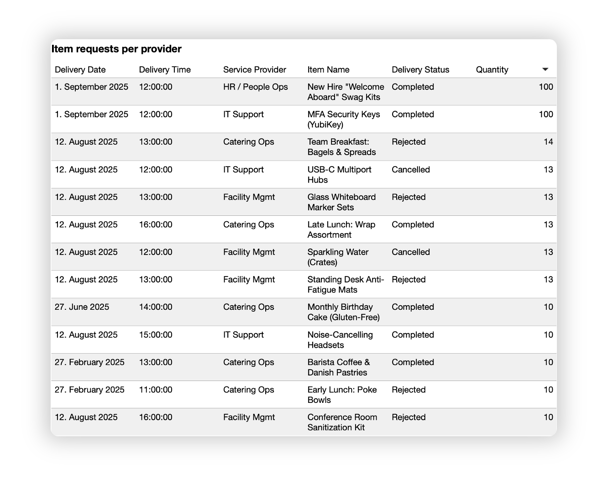
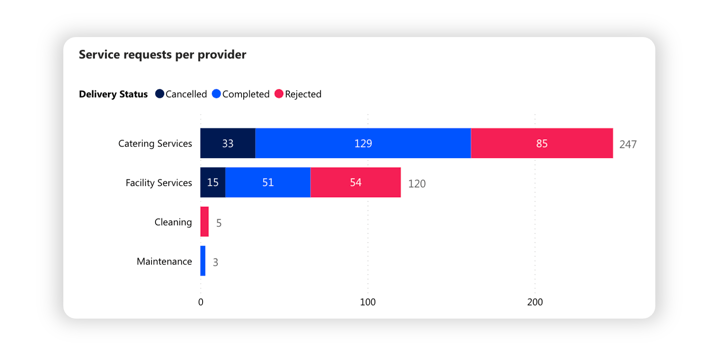
Which items do people order most? Which ones get rejected most often, and why? Are there certain times of year when catering requests spike? Is one service provider handling a disproportionate share of the workload?
These aren't just interesting questions. They're the kinds of questions that help you negotiate better contracts, plan ahead for busy seasons, and reduce the back-and-forth that slows meetings down before they even start.
When you can filter by provider, compare activity across different teams, and track how demand shifts over time, you move from reactive to proactive. Instead of discovering that the catering team is overwhelmed every September, you see it coming and prepare accordingly.
Data-Driven Meeting Management Is a Competitive Advantage
 The organizations that manage meetings well don't just have good booking systems. They have visibility into the full meeting lifecycle, from how visitors flow through reception to how services get coordinated and delivered.
That visibility is what allows them to make better decisions, faster. It's what lets a facilities manager spot a staffing problem before it becomes a guest experience problem. It's what lets an office manager see that a particular service provider has a high rejection rate and have a conversation about it before it affects a client meeting.
This isn't about gathering data for its own sake, but rather about turning operational activity into organizational intelligence.
What to Look For in Your Own Data
If you start looking at reception and service data more systematically, a few questions are worth asking:
Are there predictable peaks in visitor check-ins that your current staffing doesn't account for? If your data shows consistent spikes on certain mornings, that's a concrete reason to adjust your schedule.
What's your service rejection rate, and what's driving it? A high rejection rate from a specific provider, or for a specific category of items, often points to a process problem that's worth fixing.
Are there seasonal patterns in service demand? Companies that plan catering and facilities support around actual historical data tend to run smoother operations than those that estimate from scratch each quarter.
Which providers are most active, and which are underused? Understanding the distribution of requests across providers helps with both capacity planning and vendor management.
If you're looking for a practical starting point, AskCody Insights covers all of this in a Power BI-powered report that spans bookings, visitors, and services in one place. Learn more about what's included.