.svg)

Running Your Meeting Rooms Like a Conference Center
Client facing businesses are changing how they think about their workplaces. Law Firms, Consultants, Accounting Firms, Financial Institutions and Banks are increasingly designing dedicated areas for external meetings that resemble inhouse conference centers. These spaces are staffed by concierge and hospitality teams whose sole purpose is to deliver a refined, consistent and secure guest experience.
It is more than a trend. It reflects a deeper shift in how organizations think about trust, confidentiality and client experience. The workplace is no longer only an operational environment. It is a strategic asset and a stage on which you communicate professionalism, care and competence.
This raises an important question. If external meetings carry so much weight, why scatter them across your office instead of treating them as a unified experience that deserves focused attention?
The organizations that succeed with this shift share a common belief. They know that when you centralize external meetings in a conference center, you elevate guest experience and reduce risk. You also free your staff from friction, confusion and the accidental exposure of sensitive information.
Let’s explore why.
A Conference Center Mindset Creates Clarity and Control
External meetings differ from internal collaboration. They require extra attention to privacy, consistency and service. When these meetings take place in random corners of an office, your ability to manage them becomes limited. Every new meeting is a small gamble. Will the room be ready? Will the technology behave? Will someone walk past confidential documents on a desk?
A conference center changes the equation. It centralizes responsibility. It lets you manage the flow of people, information and services with intention. It gives you the power to ensure that every external meeting follows the same standard of preparation, security and care.
This centralization also reduces operational burden. No more chasing available rooms across multiple floors. No more ad-hoc setups for catering or AV. No more uncertainty about what guests experience when they arrive. A single point of truth replaces many small points of friction.
The question for the reader is this. Where in your current workplace do you rely on hope instead of structure? Which parts of your external meeting flow would benefit from moving from chance to design?
A Dedicated Space Elevates the Visitor Experience
The moment a guest enters your building, they start forming an impression of your organization. A well-run conference center turns that moment into a deliberate experience rather than an accidental one.
When external visitors are welcomed by a team whose full focus is on hospitality, the tone changes. They feel expected. They feel guided. They feel valued. It becomes clear that the meeting is not simply another item in the calendar. It is an event you have prepared for.
This sense of occasion does not require extravagance. It requires coherence. A clear arrival process. A warm check-in. A short walk to a dedicated meeting floor. A space that reflects attention to detail. When a visitor encounters this sequence, they understand something important about the organization. They sense competence. They sense intention.
Ask yourself. What story does your current guest experience tell? Does it signal that you take confidentiality, service and professionalism seriously, or does it leave that interpretation to chance?
Centralizing External Meetings Strengthens Confidentiality
Client facing businesses live and breathe confidentiality. Yet many firms run external meetings in areas surrounded by daily internal activity. Screens are left unlocked. Documents are visible. Conversations spill out of rooms. Even when nothing is shared intentionally, exposure risk grows.
By moving external meetings into a dedicated conference center, firms create a protective buffer between client conversations and internal work. The setup minimizes unintentional sharing. It removes visitors from operational zones. It ensures that sensitive client information stays where it belongs.
In a world of rising privacy expectations and regulatory pressure, this design choice becomes more than operational convenience. It becomes a statement about integrity.
Reflection is useful here. Have you mapped where in your office confidentiality might be compromised through innocent behavior? What would change if you redesigned the visitor journey with confidentiality as a core principle instead of an afterthought?
Some Real Life Examples
A powerful illustration of this shift comes from a recent Gensler project for a financial services client in Manhattan. The firm created what they call “The Pavilion” — a 300-person multi-purpose venue that blends the qualities of a hospitality lounge, an event hall and a modern meeting environment. Guests arrive to find a barista bar, soft lounge seating, interactive art installations and digital panel displays woven into the space. Catering and AV support are embedded into the design rather than bolted on as afterthoughts. Everything signals intentionality. The visitor senses immediately that they have entered a place designed for them, not a repurposed internal meeting room that happens to be free. It offers a glimpse of what becomes possible when external meetings are treated as experiences rather than logistics.
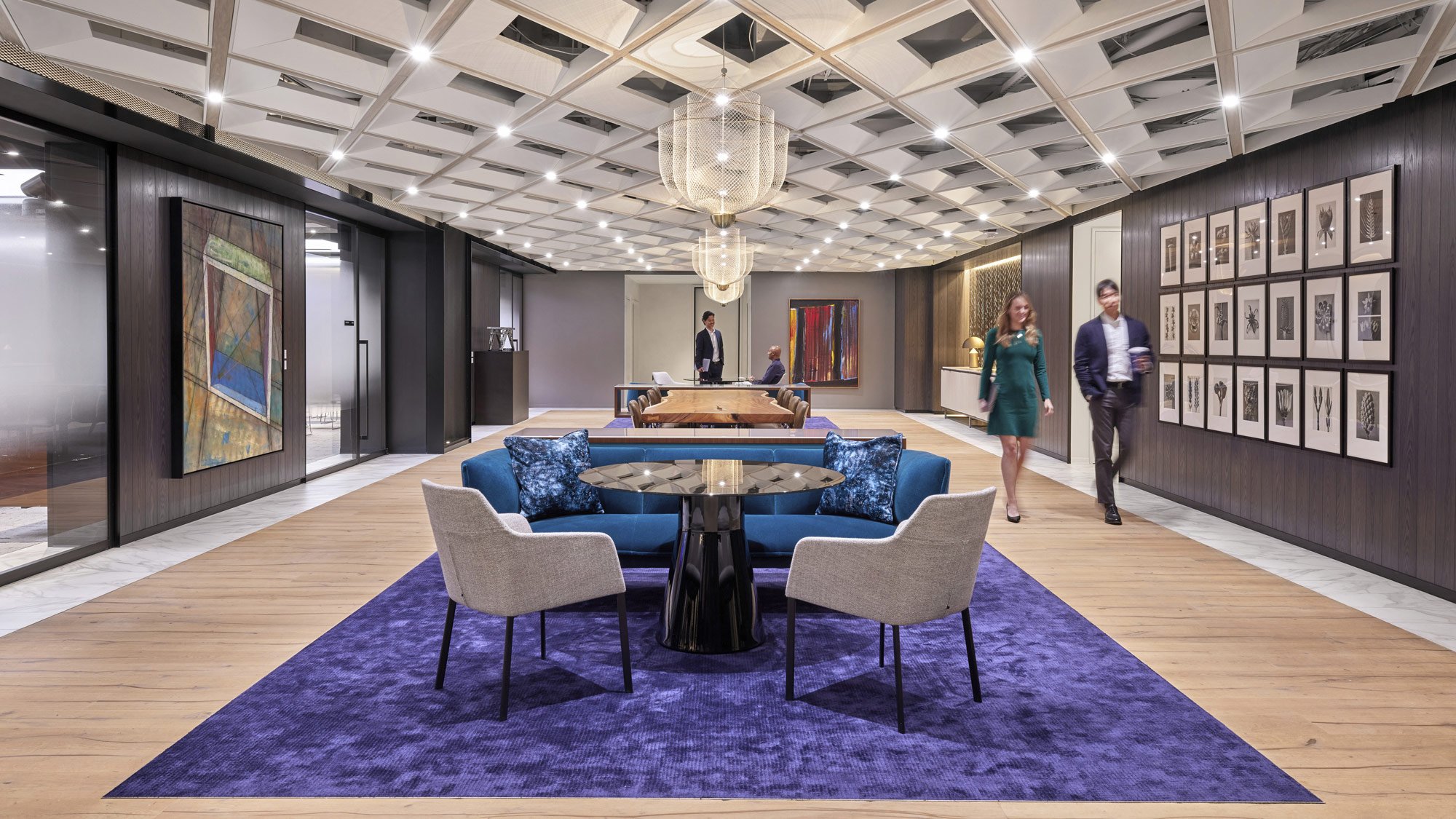
Photo by Garrett Rowland
Another example comes from a global banking headquarters also featured in the Gensler article. Here, the client deliberately placed the conference centre on a prime floor with sweeping views of Central Park.
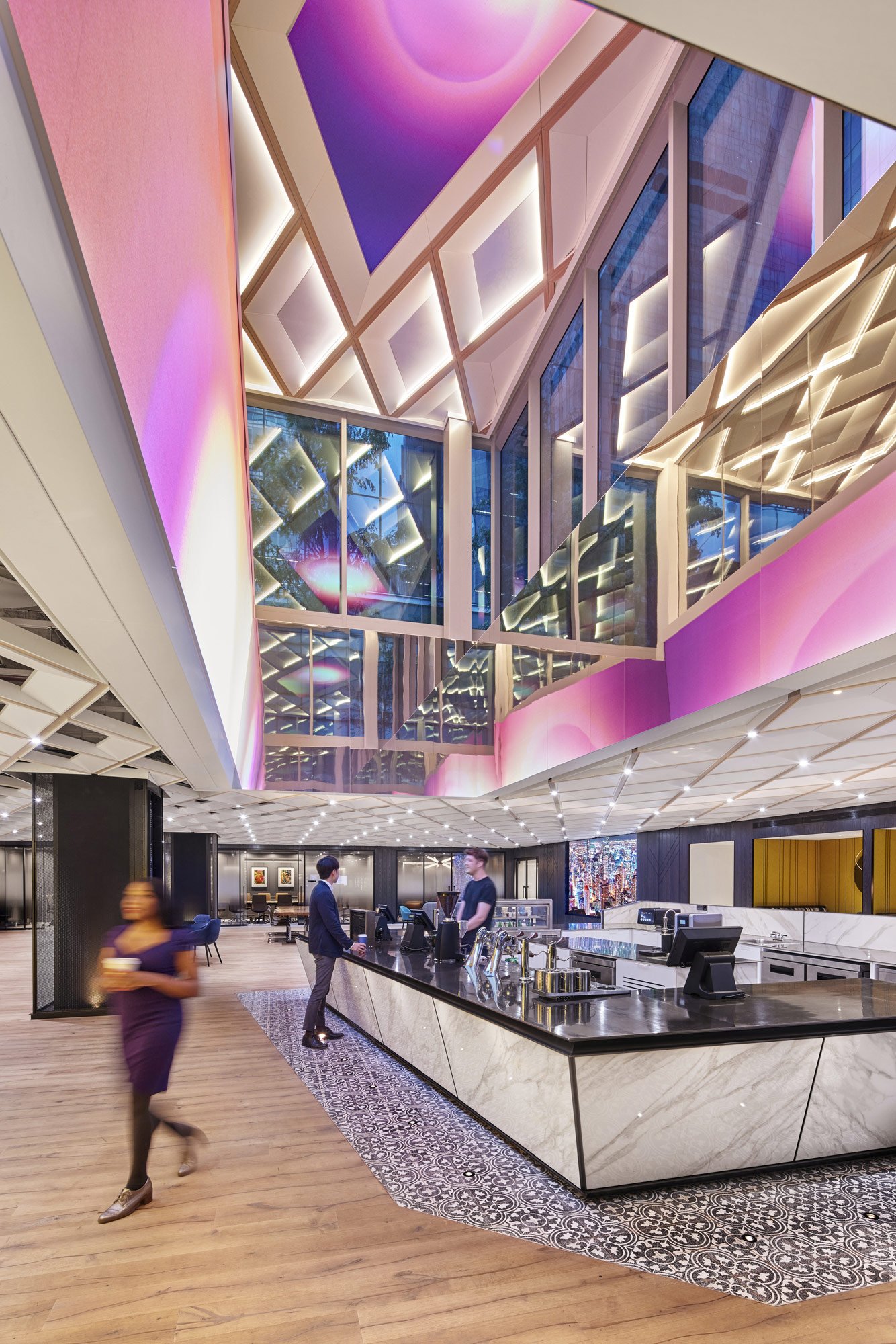
Photo by Garrett Rowland
Guests arrive at a dedicated coffee bar before entering flexible conference rooms that can expand, combine or open into a private dining space connected to an outdoor terrace. The environment communicates calm, clarity and sophistication. It is difficult for a visitor to walk into such a space and not form an impression about the bank’s professionalism and standards. By designing a hospitality-infused arrival point and a sequence of connected meeting spaces, the bank turns every external meeting into a curated moment, not just a calendar entry. It demonstrates how design, technology and guest flow become strategic tools, not mere amenities.
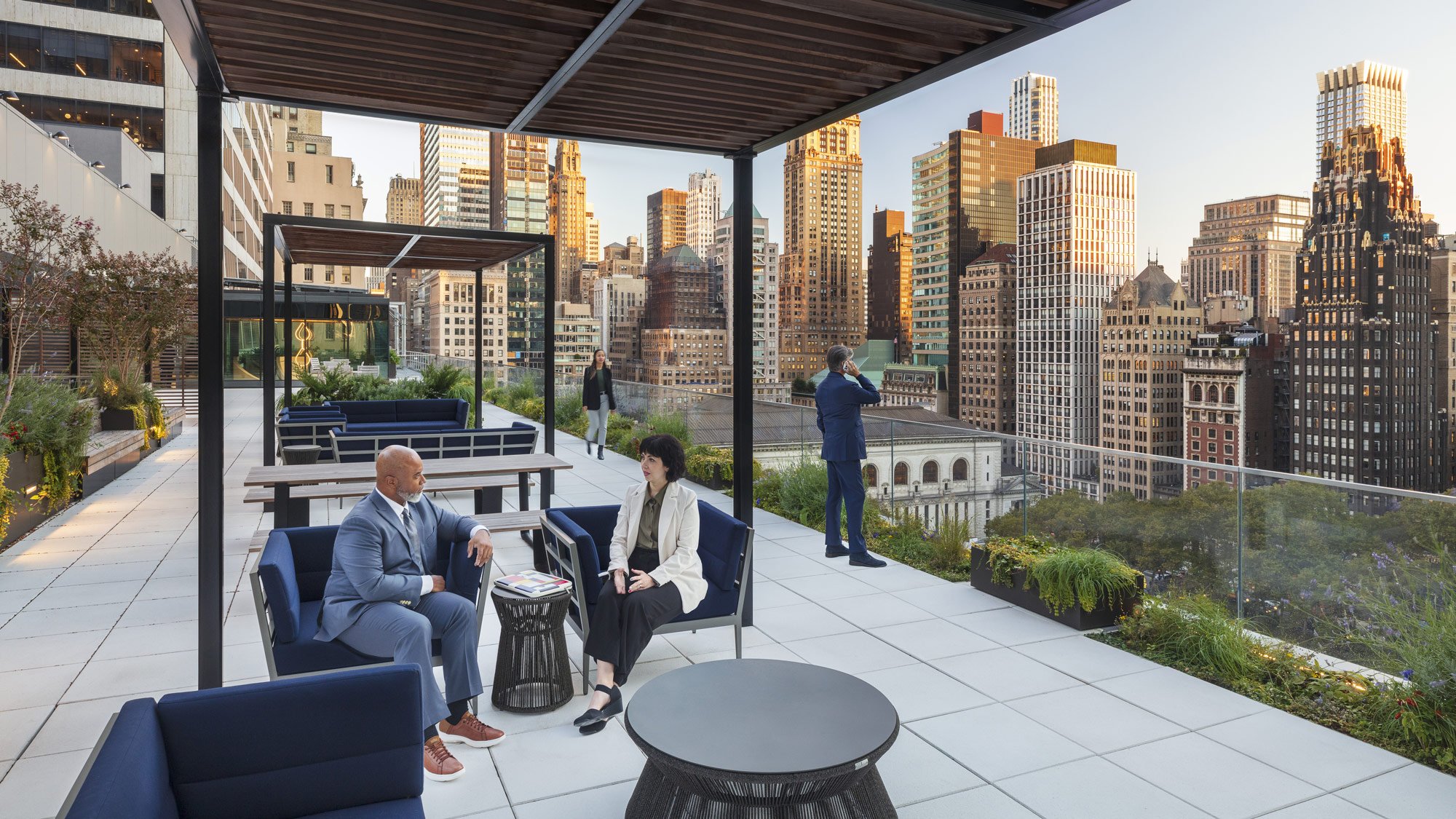
Photo by Garrett Rowland
A third example comes from AllianceBernstein’s Nashville headquarters, where the client and conference floors were designed with a hotel-lobby sensibility. Visitors enter a double-height sky lobby filled with natural light before being guided into a suite of adaptable meeting spaces and a boardroom fully equipped for hybrid collaboration. The furniture is intentionally lightweight to allow for smooth transitions between different types of gatherings, making the space equally suitable for daytime discussions and evening events. The combination of daylight, views, comfort and seamless AV creates an atmosphere that supports both focus and hospitality. It shows that external meeting spaces do not need to choose between professionalism and warmth. They can, and should, offer both.
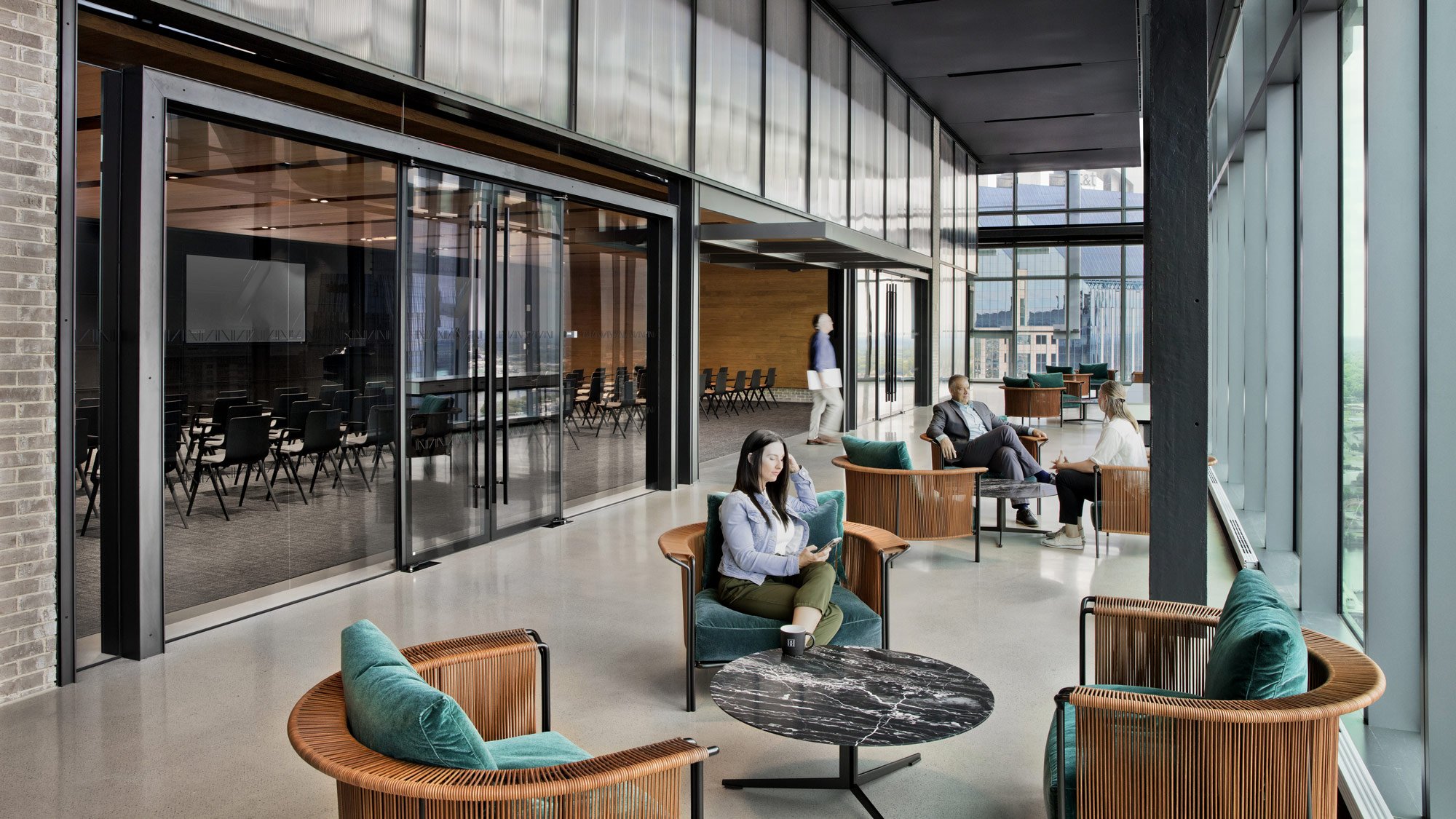
Photo by Connie Zhou
These examples reveal a pattern. Leading financial firms are not just upgrading meeting rooms. They are rethinking the entire experience around external interactions. Arrival becomes intentional. Hospitality becomes a design principle. Technology becomes invisible but dependable. And the environment becomes a reflection of the organisation’s values, attention to detail and respect for the guests’ time.
When Nykredit moved into their new headquarters at “Nykredithuset” in Copenhagen’s Nordhavn district, they quite deliberately treated the facility as more than just office space. From the outset the design by PLH Architects (with advisory from Alex Poulsen Architects) embraced a mixed-use model that integrates public reception, guest facilities, and high-end meeting zones alongside employee workspaces. With over 2,000 employees consolidated from multiple sites, Nykredit created flexible, hospitality-infused meeting and guest areas designed to accommodate external visitors in a controlled yet welcoming environment. The ground floor café and publicly accessible rooftop garden play a dual role as arrival zones for visitors and as extensions of the guest experience. Internally, meeting rooms and spaces appear to be configured with an eye towards adaptability (whether for confidential client discussions or larger stakeholder gatherings) and articulate a clear distinction between guest-facing zones and general internal workspace. This setup embodies the conference centre mindset: the external meeting journey is seen as a discrete, designed experience rather than a by-product of ordinary office usage.
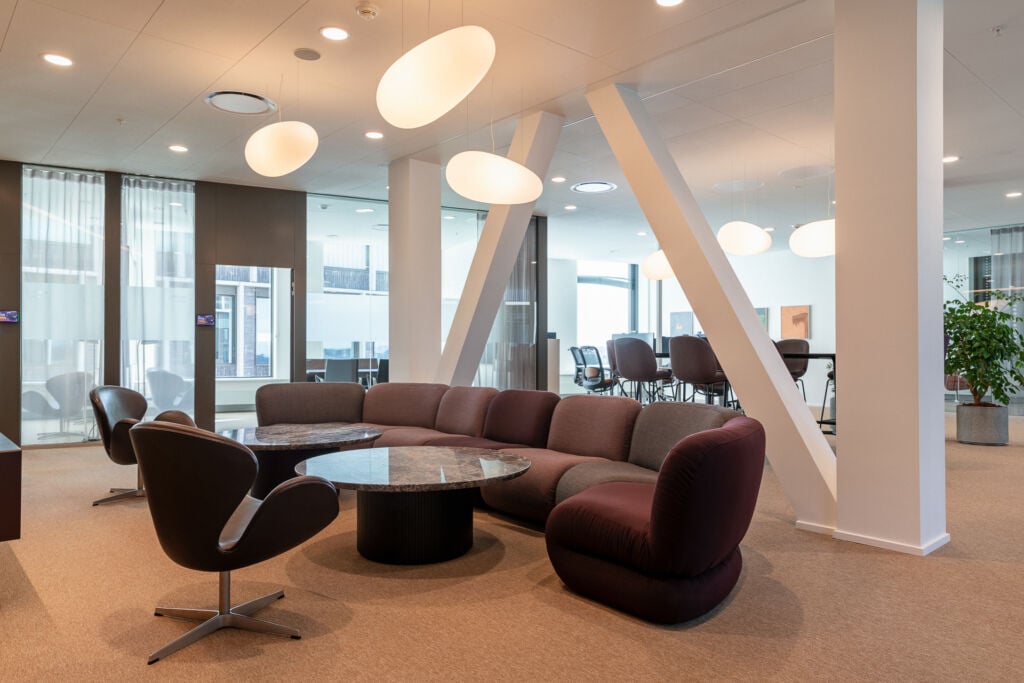
Photo by Holmris B8
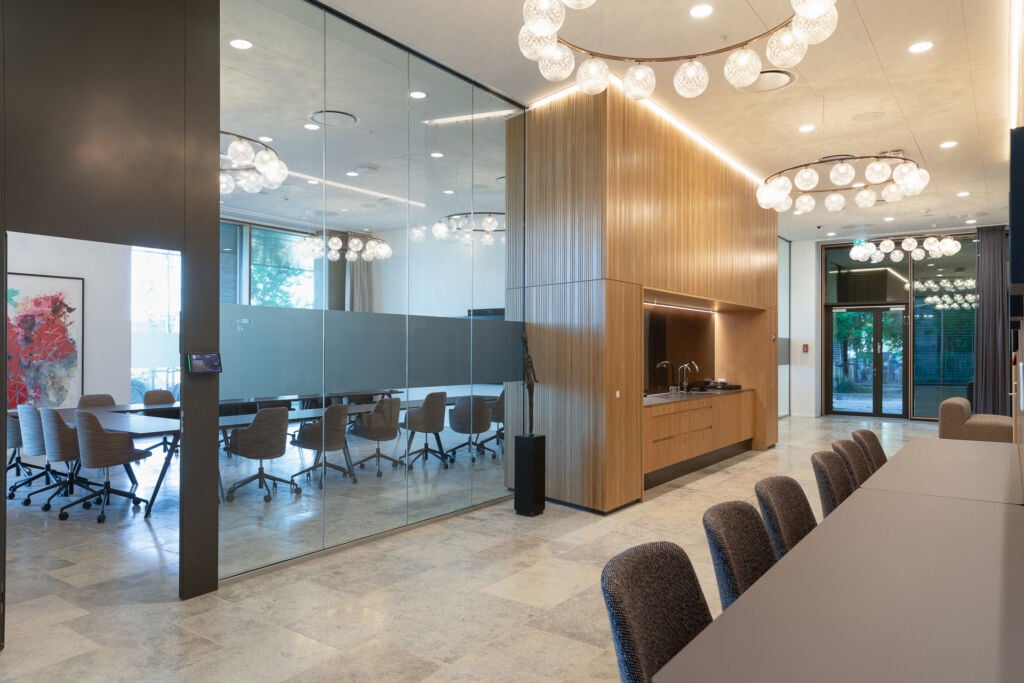
Photo by Holmris B8
This is the direction many forward-thinking firms are taking, and it offers a clear prompt for reflection. If your clients walked through your external-meeting environment today, what would their first impression be?
What To Consider When Running an Inhouse Conference Center
(And how AskCody enables you in running your inhouse Conference Center)
Creating an inhouse Conference Center for your external and client facing meetings, is not only a question of interior design. It requires operational excellence supported by the right technology and processes. Organizations that succeed with this model focus on a few essential elements.
A clear operating model
Decide who owns hospitality, room readiness, AV support, catering and visitor handling. A dedicated team can deliver the consistency that external meetings require. Without ownership, even beautiful spaces fall short.
Running an inhouse conference center requires more than attractive rooms and polished interiors. The quality of the experience depends on the rhythm behind the scenes. A conference center succeeds when every part of the operation works together with intention: hospitality, facilities, catering, technology, security, and front-of-house staff. When this coordination breaks down, the guest notices. When it works seamlessly, the experience feels effortless.
To make that consistency possible, organisations need a clear operating model (and technology like AskCody to support it!). Someone must own room readiness, someone must own hospitality, someone must own AV support, and someone must own visitor handling. Without that structure, even the best-designed space will behave like an ordinary office floor. A conference center is a living system. It only works when its responsibilities are visible, shared, and choreographed.
Strong scheduling discipline supported by a system that streamlines confererence room bookings
Centralising external meetings only works if meeting reservations, service requests, visitor pre-registration and room allocations flow through one controlled channel and a structured system and workflow . Firms that rely on fragmented tools or informal booking habits quickly discover that a conference center can become chaotic. Double bookings appear. Catering shows up in the wrong place. Guests arrive without anyone being notified. These are the frictions that erode trust.
Seamless coordination between hospitality and facilities supported by technology that gives structure rather than complexity
Running a conference center without the right tools leads to chaos. You need a platform that handles bookings, visitor management, room readiness, services, analytics and communication with precision. This is where AskCody plays a vital role. Why? Because the rhythm of a conference center depends on reliable service delivery. Catering, room setup, cleaning and support must follow a predictable pattern that is visible to everyone involved.
AskCody steps in as the spine that holds this system together. It provides the structure that teams need to operate with confidence. Instead of juggling spreadsheets, email threads or disconnected tools, organisations gain a single flow that ties together every step of the external meeting experience. Booking a room, ordering services, coordinating catering, preparing AV needs and pre-registering visitors become part of one unified process. Hospitality teams have visibility. Facilities teams know what is required and when. Reception knows who is arriving. Leaders get insight into utilisation and service demand. The whole system becomes predictable, not reactive.
.png?width=2006&height=1363&name=Group%20596%20(1).png)
Flexibility in both space and operations
Another important consideration is how the conference center behaves across the day. Many organisations want these spaces to support multiple types of gatherings: formal client discussions, internal strategy sessions, workshops, stakeholder meetings and even after-hours events. This requires flexibility in both space and operations. Lightweight furniture, modular layouts and reliable technology matter, but so does the ability to coordinate those changes without confusion. When teams can see upcoming bookings, service expectations and room transitions in a single place, adaptability becomes achievable. AskCody helps create that shared understanding so the environment can shift smoothly from one purpose to another.
A mindset that sees meetings as experiences
Conference centers thrive when organizations see meetings not as transactions but as opportunities to strengthen relationships. Hospitality, and visitor experience, becomes a strategic function rather than a cost center. Organisations must therefore think about the experience from the guest’s perspective. A conference center is not just a collection of rooms. It is a journey: arrival, check-in, wayfinding, meeting flow, hospitality touchpoints and departure. This journey needs to feel intentional and professional. A visitor management solution that connects directly to the meeting booking is a critical part of this. Guests should feel expected, not processed. They should arrive at the right place with no uncertainty. With AskCody, pre-registration, coded access, notifications and host alerts become invisible parts of the workflow. The result is an experience that feels curated rather than improvised.
The lesson is simple but demanding. Running an inhouse conference center is not just about space. It is about orchestration. If firms want their external meeting environment to reflect their professionalism, they need tools that replace assumptions with clarity, manual coordination with shared visibility and fragmented workflows with a single, coherent structure. AskCody is designed for exactly that purpose: to give organisations control over the entire meeting experience so the conference center becomes what it is meant to be, a strategic asset and a high-trust environment worthy of their clients.
Bringing it all together
Running your external meeting rooms like a conference center is ultimately a choice to treat client interactions with the attention they deserve. It brings clarity, structure and predictability. It elevates the visitor experience. It protects confidentiality. It strengthens your brand. It also frees internal teams from the daily micro-frictions that drain time and focus.
In a world where trust and professionalism define competitive advantage, firms cannot afford to leave the guest experience to chance. A well-designed conference center turns every external meeting into a moment of intention. It signals that the organization is thoughtful. It signals that you understand the value of your client’s time. It signals that you operate with precision.
If you rethink your external meeting strategy today, what would you change first?