.svg)

Six Months Into 2026: The Office Is Back. Your Meeting Operations Aren't.
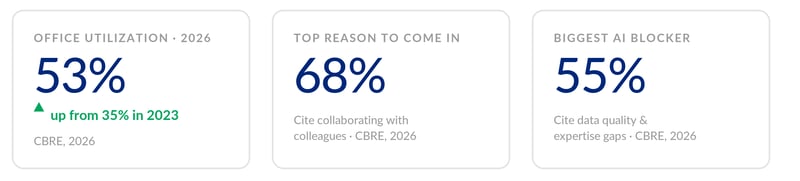
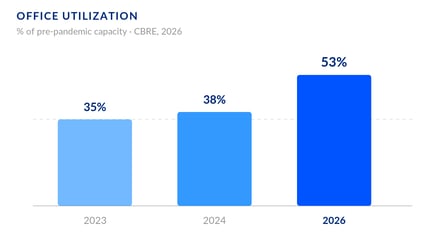
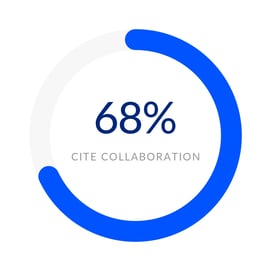
Your building is fuller than it has been in years. The floors that stood half empty through 2023 and 2024 are humming again, and the meeting rooms are the first thing to fill up. If you run workplace, IT, or facilities for a mid-market organization, you already know this: 2026 is the year the office earned its keep back. Office utilization has climbed to 53%, the highest level since before the pandemic, up from just 35% two years ago (CBRE, 2026). And 68% of employees say they come in for one reason above all: to collaborate with colleagues (CBRE, 2026). People are not returning for the desk. They are returning for the meeting. The trouble is, most booking, service, and visitor systems were built for a much emptier building, and at 53% utilization, every gap in that system now shows up daily instead of occasionally.
The fix is not more meeting discipline. It's one system that follows the meeting everywhere it goes, room, service, visitor, and insight, so growth in attendance does not automatically mean growth in chaos. More on that below.
The Halfway Point: Occupancy Just Had Its Best Run Since the Pandemic
Start with the number, because it is the story of the first half of 2026. CBRE's 2026 Global Workplace & Occupancy Insights puts global office utilization at 53%, against 38% in 2024 and 35% in 2023 (CBRE, Part 1). That is not a seasonal wobble. It is the highest reading since before March 2020, and it has climbed for three straight years running.
What is pulling people back is not ambiguous. 68% name collaborating with colleagues as the main reason they choose to come in (CBRE, Part 2). Not a desk, not a mandate on paper. A meeting worth showing up for. If your building is fuller than it has been in five years, is your meeting operation actually keeping pace with that, or is it just quietly absorbing the extra load?
The Coordination Tax Nobody Line-Itemed
Here is the part the occupancy headlines miss. Most booking, catering, and visitor workflows were never designed. They were assembled, informally, over years, for a building that sat somewhere around a third full. At that level, a double-booked room, a catering order sent to the wrong floor, or a visitor stuck in reception because nobody flagged the meeting move, is rare enough to shrug off and fix by hand.
At 53% utilization, the same gaps do not stay rare. They compound daily. More meetings mean more room changes, more service requests, more guests, more chances for one system not to know what another system just did. Most teams still manage this by feel, checking a calendar here and a spreadsheet there, rather than by actual utilization data. That is not a staffing problem. It is an operating model built for an occupancy level the building no longer has.
AI Showed Up to the Meeting Before Governance Did
The second half of the H1 2026 story is AI, and it arrived faster than most organizations' coordination groundwork. Microsoft's 2026 Work Trend Index Annual Report, published in May, frames the moment directly: as AI and agents take on more of the actual execution of work, the open question is whether organizations are structured to capture that value (Microsoft Work Trend Index, 2026).
That question lands hard on the workplace. CBRE's same research series found 55% of organizations name data quality and a lack of in-house expertise as the biggest obstacles to using AI and analytics to optimize their space (CBRE, Part 3). Layering AI on top of a coordination system that still does not have one trustworthy record of what is actually happening in a meeting will not fix the coordination tax described above. It will just make the guesswork faster. Fix the plumbing before you automate it.

The most-cited obstacle to using AI and analytics to optimize workplace space. CBRE, 2026.
Where the Meeting Journey Holds This Together
This is the layer AskCody was built to hold: a single source of truth for every meeting, from booking through service through visitor through insight, so growth in attendance does not automatically mean growth in chaos. We call the underlying logic Follow-the-Meeting Intelligence: every room, service, and visitor tied to the meeting object itself, so when the meeting changes, everything tied to it changes automatically, instead of falling to whoever notices first.
None of this requires ripping out Outlook or Teams. It runs natively on top of the AskCody Platform, on the Microsoft 365 data you already generate every time someone books a room.
A Few Fun Facts to Mark the Halfway Point
- Long before the calendar invite existed, the ancient Greeks were doing this in the open air: business, politics, and plain old gossip, all thrashed out together in the Agora.
- The modern boardroom has a specific birthday. In 1906, Frank Lloyd Wright completed the Larkin Administration Building in Buffalo, New York, widely cited as one of the first true open-plan offices in American business history, built explicitly to bring people together to coordinate work.
- Nearly every workplace occupancy report published this year agrees on one thing: Tuesday is still the busiest meeting day of the week, and Friday the emptiest.
Bringing It Together
More people in the building. More meetings on the calendar. More services to coordinate around each one. None of that is a problem to solve away. It is the shape of a healthy office in 2026, and it is worth building for on purpose rather than absorbing by accident.
The question worth carrying into the second half of the year is not whether people are coming back to the office. CBRE's data already answers that. It is whether your meeting operations are actually ready for them when they do.
Key takeaways
- Office utilization hit 53% in 2026, the highest level since before the pandemic and up from 35% just two years ago (CBRE).
- 68% of employees say collaborating with colleagues, not desk work, is the main reason they come in (CBRE): meetings, not desks, are driving the return to office.
- Coordination systems built for a near-empty building are now straining under real, daily use, turning occasional friction into a routine tax.
- AI is entering the workplace stack (Microsoft's 2026 Work Trend Index), but 55% of organizations say data quality and expertise gaps still block AI-driven space optimization (CBRE). The coordination layer has to be solid before automation sits on top of it.